

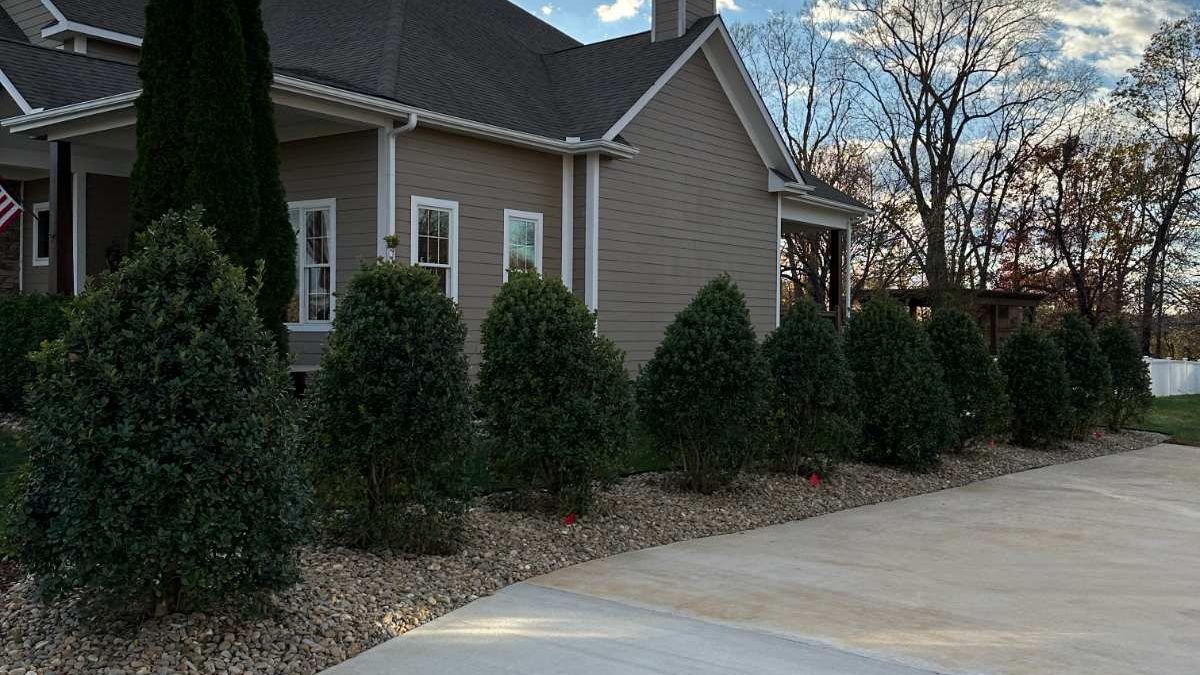
In East Tennessee, we can get a week of heavy rain followed by a stretch of heat and humidity, and our clay soil does not make it any easier. Clay holds water, compacts easily, and can bake hard in summer. The result is a lot of shrubs that look great at the garden center, then struggle in real life with yellow leaves, root issues, and constant “rescue watering.”
This guide is our field-tested list of low maintenance shrubs East Tennessee homeowners can count on, especially in Kingston, Knoxville, Oak Ridge, Lenoir City, Loudon, and across Roane County. We are focusing on shrubs that tolerate clay, handle humidity, and keep their shape with minimal pruning. You will also get placement tips for sun versus shade, simple drainage improvements that actually work in clay, and a straightforward planting and watering plan designed to reduce long-term maintenance.
If you want foundation plantings East Tennessee neighbors will notice, without spending every weekend trimming and replacing plants, start here.
What makes East Tennessee clay soil tough on shrubs
Clay is not “bad soil,” but it behaves differently than loam. Around Kingston and the Tennessee Valley, we commonly see dense red or orange clay with a thin topsoil layer. It has two traits that matter most for shrubs:
- Slow drainage after storms: Clay particles are tiny and pack tightly, so water moves through slowly. That can suffocate roots if a shrub is planted too deep or in a low spot.
- Hard compaction in dry weather: When it dries, clay shrinks and hardens. New roots have a harder time pushing through, and the soil can pull moisture away from the root ball.
Add East Tennessee’s humidity and temperature swings, including occasional winter cold snaps and freeze-thaw cycles, and you get a perfect recipe for stress.
The biggest planting mistake we see in clay
Most shrub failures in clay start with the same issue: planting too deep. In clay, a shrub set even a couple inches too low can sit in a “bathtub” of water. We recommend setting the root flare slightly above finished grade, then building a gentle mulch ring, not a mulch volcano.
When shrubs fail, drainage is usually the real culprit
If you have areas that stay soggy, choosing “tough shrubs” helps, but it does not fix the site. In those spots, we often pair planting with targeted drainage solutions, bed shaping, or a rain garden approach. If runoff and puddling are common at your home, our clay-specific drainage article is a helpful next step: How to Build a Rain Garden in East Tennessee Clay Soil.
Best low-maintenance shrubs for clay soil in Tennessee (sun and part sun)
These are our go-to shrubs for clay soil Tennessee landscapes where you want reliability, strong structure, and fewer chores. Sun exposure is a major factor, so we are grouping picks by where they perform best.
Panicle hydrangea (Hydrangea paniculata)
If you want big blooms without babying the plant, panicle hydrangea is one of our most dependable choices for East Tennessee. Unlike bigleaf hydrangeas, it blooms on new wood, so late frosts are less of a concern.
- Light: Full sun to part shade (morning sun is ideal)
- Why it works in clay: Tough roots, adaptable, and forgiving once established
- Maintenance level: Low, prune in late winter if you want to shape or size-control
- Placement tip: Give it air flow to reduce leaf spot in humid summers
Great cultivars include ‘Limelight’, ‘Little Lime’, and ‘Bobo’ for tighter spaces.
Spirea (Spiraea japonica)
Spirea is a workhorse for foundation plantings East Tennessee homeowners want to look tidy with minimal effort.
- Light: Full sun for best flowering
- Clay tolerance: Good, as long as the site is not constantly waterlogged
- Maintenance level: Low, optional light shear after flowering for a second flush
- Placement tip: Use in masses for a clean, repeatable look along walkways
Ninebark (Physocarpus opulifolius)
Ninebark is tough, drought tolerant once established, and holds up well in clay. Many cultivars have dark foliage that adds contrast.
- Light: Full sun to part shade
- Maintenance level: Low, prune selectively to keep a natural shape
- Placement tip: Use as a backdrop shrub, it can get large if you let it
Cultivars like ‘Diabolo’ and ‘Summer Wine’ bring strong color without constant pruning.
Juniper (Juniperus spp.)
For evergreen shrubs Tennessee landscapes can rely on, junipers are hard to beat, especially on slopes and hot exposures.
- Light: Full sun
- Clay tolerance: Good, but they hate standing water
- Maintenance level: Very low, avoid shearing into tight balls
- Placement tip: Use creeping types for erosion control, upright types for screening
If you want a “plant it and leave it” option, this is often it.
Inkberry holly (Ilex glabra)
Inkberry is a broadleaf evergreen that can be a cleaner alternative to boxwood in many East TN sites.
- Light: Full sun to part shade
- Clay tolerance: Good, prefers consistent moisture but can handle clay if not waterlogged
- Maintenance level: Low to moderate, occasional thinning keeps it full
- Placement tip: Choose improved cultivars like ‘Shamrock’ for better density
Virginia sweetspire (Itea virginica)
- Light: Sun to shade (best flowering in part sun)
- Maintenance level: Low
- Placement tip: Excellent near downspout splash zones where other shrubs struggle
For homeowners asking for drought tolerant shrubs East TN yards can also use in “problem spots,” sweetspire is a smart compromise because it tolerates both moisture and average conditions once established.
Best shade shrubs for clay soil (and humid summers)
Shade can be just as challenging as clay, especially under mature oaks and maples where roots compete for water. These shade shrubs clay soil sites tend to handle well, with the right planting approach.
Oakleaf hydrangea (Hydrangea quercifolia)
Oakleaf hydrangea is one of our favorite shrubs for East Tennessee because it looks good in multiple seasons, blooms well in part shade, and has strong fall color.
- Light: Part shade, tolerates more sun with moisture
- Clay tolerance: Good if planted correctly and mulched
- Maintenance level: Low, minimal pruning needed
- Placement tip: Give it room, many cultivars spread wider than expected
Aucuba (Aucuba japonica)
For deep shade near foundations or under porches, aucuba is a reliable evergreen with speckled foliage.
- Light: Shade to part shade (avoid hot afternoon sun)
- Clay tolerance: Good with improved planting hole and mulch
- Maintenance level: Low
- Placement tip: Protect from winter wind exposure in open areas
Mahonia (Mahonia bealei or Mahonia aquifolium)
Mahonia brings a bold texture and winter interest with yellow blooms. It is not for every style, but it is tough.
- Light: Shade to part shade
- Clay tolerance: Good once established
- Maintenance level: Low, remove older canes if it gets leggy
- Placement tip: Use as a focal point in shaded beds
Leucothoe (Leucothoe fontanesiana)
Leucothoe is an underused evergreen for shade that plays well in woodland-style beds.
- Light: Shade to part shade
- Clay tolerance: Moderate to good, prefers organic matter and consistent moisture
- Maintenance level: Low
- Placement tip: Works well on the north side of homes and in protected courtyards
Dwarf yaupon holly (Ilex vomitoria)
If you need a small evergreen that behaves, dwarf yaupon is one of the cleanest choices we install.
- Light: Sun to shade (best form in sun to part shade)
- Clay tolerance: Good
- Maintenance level: Very low
- Placement tip: Excellent for foundation plantings where you want a neat, rounded form without constant shearing
Placement and drainage tips that reduce maintenance long term
Choosing the right shrub is only half the battle. The other half is placing it where it can succeed with minimal inputs.
Match the shrub to sun, heat, and reflected light
In Kingston and across the Knoxville area, we see many foundation beds that get blasted by reflected heat from brick, stone, and concrete. That is where “full sun” shrubs can still scorch if the soil dries out.
- Put junipers, spirea, and ninebark on the hottest exposures.
- Use oakleaf hydrangea, aucuba, and leucothoe where afternoon shade protects foliage.
- For mixed beds, keep taller shrubs slightly off the wall to improve air flow and reduce disease pressure in humid months.
Build the bed for drainage, not just looks
In clay, a flat bed can act like a shallow bowl. We often recommend a subtle regrade so water moves away from the foundation and does not pool around root balls.
Practical options:
- Slightly raised planting beds (even 4 to 6 inches helps)
- Compost topdressing to improve structure over time
- Mulch for moisture moderation, not for “hiding” bad drainage
If you have slopes or need more structure, retaining and hardscape elements can help control water and soil movement. That is where our Hardscaping team often ties planting beds into the overall yard plan.
Use mulch correctly in clay
Mulch is one of the cheapest maintenance reducers you can buy, but only if it is applied correctly.
- Keep mulch 2 to 3 inches deep.
- Pull mulch back a few inches from shrub stems.
- Refresh lightly each year instead of piling it higher.
If you are deciding between common East TN options, our comparison can help you choose what performs best in your beds: Mulch vs Pine Straw in Knoxville: Costs, Pros and Cons for East Tennessee Beds.
A simple planting and watering plan for low-maintenance success
We install shrubs across Roane County and surrounding areas, and the biggest difference between “low maintenance” and “constant work” is the first 8 to 12 weeks after planting. Clay soil can fool you because it stays wet on top, while the root ball dries out, or the opposite happens after a storm.
Step 1: Pick the right planting window
In East Tennessee, the easiest establishment windows are:
- Fall (September to early November): Warm soil, cooler air, and more consistent rainfall
- Early spring (March to April): Good rooting time before summer heat
Summer planting can work, but it requires a more disciplined watering plan.
Step 2: Dig the hole wide, not deep
Our standard approach:
- Dig the hole 2 to 3 times as wide as the root ball.
- Dig it no deeper than the root ball height.
- Set the shrub so the top of the root ball sits 1 to 2 inches above the surrounding grade.
In clay, that slight “high set” helps prevent the bathtub effect.
Step 3: Backfill smart (do not create a container)
We typically backfill with the existing soil, breaking up clods, and mixing in modest organic matter if the clay is extremely tight. The goal is to encourage roots to leave the planting hole, not stay in a rich pocket.
- If you amend heavily, do it across the whole bed, not just one hole.
- Avoid adding sand to clay, it can create a concrete-like mix.
Step 4: Water deeply, then taper
Here is a simple plan we give homeowners for shrubs in clay:
- Week 1 to 2: Water every 2 to 3 days if there is no soaking rain. Apply enough to wet the root ball and the surrounding soil.
- Week 3 to 6: Water 1 to 2 times per week, depending on heat and rainfall.
- Week 7 to 12: Water weekly during dry spells.
- After 3 months: Most established shrubs only need supplemental water during extended drought.
Two important notes:
- Watering should be deep and slow, not a quick sprinkle. Soaker hoses or drip lines are ideal for consistent moisture without disease pressure.
- Check moisture 3 to 4 inches down near the root ball. Clay can be wet on the surface and dry underneath.
If you are considering drip or sprinkler options to reduce long-term effort, our guide can help you decide what fits your property: Irrigation Systems in East Tennessee: Do You Need One?.
Step 5: Fertilize lightly, if at all
Most shrubs do not need heavy feeding, especially in the first year. Too much nitrogen can push soft growth that attracts pests and needs more pruning.
- Use a light, slow-release shrub fertilizer in spring if growth is weak.
- Focus more on compost, mulch, and correct watering.
Low-maintenance layout ideas for foundation plantings in East Tennessee
Shrub selection is easier when you have a simple layout strategy. In our Landscaping projects, we aim for repeatable patterns that look intentional and are easy to maintain.
The “evergreen backbone plus seasonal accents” approach
For many homes in Knoxville, Oak Ridge, and Lenoir City, we build beds with:
- Evergreen structure: inkberry, dwarf yaupon, juniper
- Flowering shrubs for impact: panicle hydrangea, spirea
- A native problem-solver: sweetspire near runoff zones
This keeps the bed looking good in winter, and it prevents the common issue of a front yard that looks empty from November through March.
Spacing that prevents constant pruning
General spacing guidelines we use:
- Small shrubs: 3 to 4 feet on center
- Medium shrubs: 4 to 6 feet on center
- Large shrubs: 6 to 10 feet on center
If you want a tighter look sooner, use perennials or groundcovers between shrubs, rather than planting shrubs too close.
Edge definition reduces weeding and makes mowing easier
If you are deciding between edging materials, this comparison is useful: Landscape Bed Edging in Knoxville: Metal vs Plastic vs Stone.
When clay soil needs more than plant selection
Sometimes shrubs struggle because the site is actively working against you. We see this often in low areas, near downspouts, or at the base of slopes where water concentrates.
Consider upgrading the site if you notice:
- Water standing in beds for more than 24 to 48 hours after rain
- Soil that smells sour or stays slick and sticky for days
- Shrubs that repeatedly yellow, drop leaves, or die back despite watering
In those cases, drainage and grading adjustments can be the difference between replacing plants every year and having a landscape that settles in and gets easier.
If you want help building a plan that fits your yard and your schedule, our Property Maintenance team can also keep beds mulched, trimmed, and healthy through the seasons.
We work throughout Roane County and nearby communities like Knoxville, Oak Ridge, Lenoir City, and Loudon, and we see the same clay challenges across the region.
Conclusion: A clay-smart shrub plan that stays attractive with less work
The best low-maintenance shrubs for East Tennessee clay soil are the ones that match your sun exposure, tolerate our humidity, and are planted correctly so roots can breathe. For sunny beds, we often lean on panicle hydrangea, spirea, ninebark, and junipers. For shade, oakleaf hydrangea, aucuba, leucothoe, and mahonia can thrive when you improve the bed, mulch properly, and avoid planting too deep.
If you take one thing from this guide, let it be this: in clay, drainage and planting depth matter as much as plant choice. A slightly raised bed, a wide planting hole, and a tapered watering schedule in the first few months will do more to reduce long-term maintenance than any “miracle” product.
If you would like us to design and install a clay-smart shrub layout, or refresh existing foundation plantings, explore our Landscaping services or reach out through our website to get a plan built for your Kingston-area property.


