

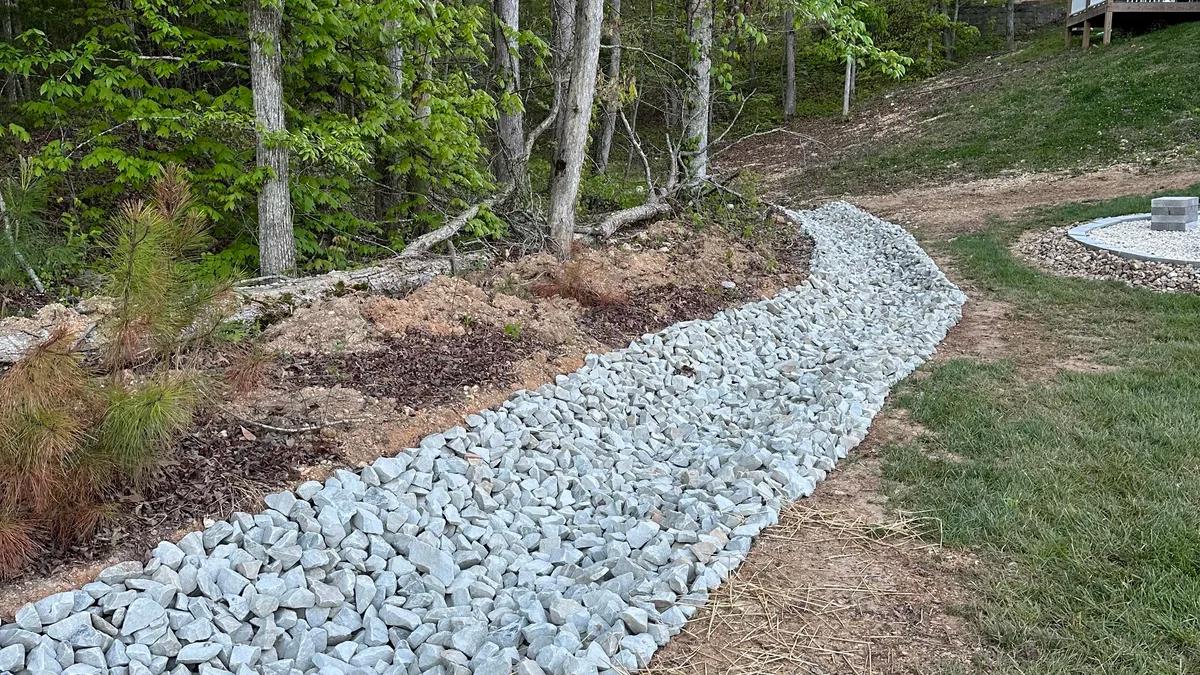
Knoxville and the surrounding East Tennessee area can go from dry to drenched fast. When that happens, runoff looks for the easiest path, and it often finds it across lawns, along driveways, and straight toward foundations. If you are dealing with soggy turf, muddy washouts, or a low spot that never seems to dry, a drainage swale may be the simplest stormwater runoff solution in TN.
In this guide, we will explain what is a swale drainage solution, when a drainage swale in Knoxville works better than pipes, catch basins, or full regrading, and how we shape and vegetate swales so they hold up to East Tennessee downpours. We will also walk through what to expect during installation, including common site constraints like clay soil, utilities, and tight side yards.
Our goal is to help you choose a fix that actually matches your yard and your maintenance tolerance, not just the trendiest option.
What a drainage swale is (and what it is not)
In practice, a swale can do three important jobs:
- Intercept runoff coming off a hill, neighbor’s yard, or a hard surface like a driveway.
- Slow water down so it causes less erosion.
- Spread and infiltrate some water into the soil when conditions allow.
- A French drain (which is a subsurface pipe-and-stone system).
- A ditch with steep sides that is hard to mow and easy to erode.
- A “fix” for every drainage problem (sometimes a swale is the wrong tool).
In East Tennessee, we often see swales used as a “no-pipes” approach to fix standing water without pipes, especially when the issue is surface runoff rather than groundwater.
Why swales are popular in East Tennessee yards
Swales work well here because they can be designed around common local realities:
- Clay-heavy soils that drain slowly and create puddling after storms.
- Short, intense rain events that overwhelm small drains.
- Rolling grades where water naturally wants to travel across the property.
When we build a swale correctly, it becomes part of the landscape, not an eyesore. It can look like a subtle contour, a planted ribbon, or a naturalized “green drainageway” that blends into the yard.
Drainage swale Knoxville: when swales work best
Here are the situations where we most often recommend a swale in Knoxville and nearby communities.
1) You have sheet flow runoff coming from a slope
If you see water “sheeting” across the lawn during storms, a swale can intercept it and carry it along a controlled path. This is common in:
- Backyards below a wooded slope
- Side yards between homes
- Lots where a neighbor’s grade pushes water across the property line
- Turf loss and bare soil
- Rills that turn into gullies
- Mulch washouts in landscape beds
If erosion is part of the problem, you may also find our related guidance helpful: How to Stop Clay Soil Erosion on East TN Slopes.
2) You need a low-maintenance drainage option
Many homeowners want a solution that does not rely on hidden pipes that can clog, collapse, or require frequent cleanouts. Swales are visible and easy to monitor. If something is not flowing right, you can see it.
- You do not want yard drains, pop-ups, or multiple basins
- You prefer a solution that can be mowed or planted
- You want fewer underground unknowns near tree roots
That said, swales still need occasional maintenance, mostly vegetation management and keeping the channel free of debris.
3) You have space to create a gentle, mow-friendly shape
Swales need room to be shallow and stable. If we can build a wide-bottomed channel with gentle side slopes, it will be easier to maintain and less likely to erode.
As a rule of thumb, swales are easier when:
- The yard is not extremely tight
- We can keep side slopes gentle enough for your mower
- There is a safe outlet point (more on outlets below)
If you are in a tight urban lot in Knoxville, we sometimes combine a small swale with a short section of drain or a dry creek bed, depending on where the water needs to go.
4) You need to move water away from a patio or outdoor living area
Outdoor living spaces in East Tennessee take a beating from runoff if the surrounding grades are not right. A swale can be used as a perimeter collector that keeps water from crossing a patio or pooling at its edge.
If you are planning hardscape work, it is smart to address drainage at the same time. Our Hardscaping team often coordinates grades, base elevations, and drainage features so the finished space stays usable after heavy rain.
Swale vs French drain vs regrading: how to choose the right fix
Homeowners often ask us to compare options. The real answer depends on where the water is coming from, how it behaves during storms, and what constraints your property has.
Swale vs French drain
When people search “swale vs french drain,” they are usually deciding between a surface solution and a subsurface one.
- The issue is surface runoff that needs direction
- You have room for a gentle channel
- You want visibility and simpler maintenance
- Water is collecting in a low area with no surface outlet
- You need to move water through a narrow corridor (like a side yard)
- You need to intercept water at the base of a slope and move it away underground
In our experience around Knoxville, French drains can struggle if they are installed too shallow, wrapped incorrectly, or placed in heavy clay without proper outlet planning. Pipes are not “set it and forget it.” They still need cleanouts, correct pitch, and an outlet that will not back up.
If you want a deeper comparison of drainage approaches, this related post is a good companion read: French Drain vs. Dry Creek Bed for East TN Drainage.
Swale vs full regrading
Regrading means reshaping larger areas of the yard to change overall flow patterns. It is sometimes the right answer, but it can be disruptive and expensive if you have established landscaping.
- The yard is mostly fine, but one flow path is causing problems
- You want a targeted fix instead of tearing up the whole lawn
- You need to capture runoff before it reaches a problem area
Full regrading is often better when:
- The entire yard is pitched toward the house
- Multiple low spots indicate an overall grade issue
- You have foundation drainage concerns and need broader correction
If you suspect your yard needs more than a swale, we recommend reading: Kingston TN Yard Grading: Signs You Need Regrading. Even if you are in Knoxville, the grading principles are the same.
When a swale is not the right solution
We are candid with homeowners when a swale will not perform well. Common deal-breakers include:
- No safe outlet (water has nowhere to go)
- Very flat yards where you cannot create consistent slope
- Extremely tight spaces where the swale would be too steep or too narrow
- High groundwater issues where water is coming up from below, not running across the surface
In those cases, we may recommend a different stormwater runoff solution in TN, such as targeted regrading, a drain system, or a combination approach.
Yard swale design East Tennessee: shape, slope, and outlet planning
The basic swale profile we aim for
Most residential swales we install are:
- Shallow enough to mow or walk across
- Wide-bottomed so flow spreads instead of cutting a rut
- Gently sloped on the sides so soil stays in place
We typically avoid narrow, V-shaped channels in lawns because they concentrate flow and erode faster in clay soil.
Slope and flow, enough fall to move water without erosion
When we evaluate a site in Knoxville, we look at:
- Where water starts (roof runoff, hillside runoff, driveway runoff)
- The “line of travel” water already wants to follow
- How much vertical drop we have to work with
- Where we can discharge water safely without creating a new problem
Outlet planning is the make-or-break detail. A swale should discharge:
- Away from the home’s foundation
- Away from neighboring structures
- To a stable area that can handle concentrated flow
Depending on the property, that could be a wooded edge, an existing drainage corridor, or a natural low area that already carries stormwater.
Designing for East Tennessee clay and heavy rain
Clay soil changes how swales behave. In many Knoxville neighborhoods, soil infiltration is slow, so the swale’s job is often more about conveying water than soaking it all in.
To make swales hold up in clay, we often incorporate:
- Topsoil improvements in planted swales to help roots establish
- Erosion control matting on steeper sections until vegetation takes over
- Check dams (small, subtle grade breaks) in longer runs to slow water
- Armoring at the outlet (stone or similar stabilization) to prevent scour
If your yard also has hardscape features like retaining walls, drainage planning should be coordinated. Poor wall drainage can create wet zones that look like “yard drainage” issues but are actually wall-related. This post explains what proper wall drainage looks like: Retaining Wall Drainage: Gravel, Pipe and Weep Holes Explained.
Vegetation and finishing options: turf swale, planted swale, or dry creek style
One of the biggest advantages of swales is flexibility. You can finish them in a way that fits your yard and your maintenance preferences.
Option 1: Turf swale (mowable and subtle)
- You want a clean, traditional look
- You need easy access for mowing
- Flow volumes are moderate and erosion risk is low
Key success factors:
- Smooth grading with no abrupt edges
- Healthy turf establishment (often with erosion matting until rooted)
- Avoiding compaction in the swale bottom
Option 2: Planted swale (more infiltration and better erosion control)
- You get frequent runoff and want better soil holding power
- The swale is in a bed area or along a property edge
- You want a more natural landscape look
In East Tennessee, plant selection matters. We look for plants that can handle both wet periods and dry spells. Native and adaptive plants often do well because they are built for our heat, humidity, and clay.
If you want ideas for plant palettes that behave well in our region, this is a helpful resource: Native Plants for East TN: Low-Maintenance Landscape Picks.
Option 3: Swale with stone reinforcement (a “hybrid” approach)
Sometimes a swale needs extra protection in the bottom or at the outlet. In those cases, we may use:
- A stone-lined low-flow channel
- River rock at the outlet
- A short dry creek bed section where water concentrates
This hybrid approach can be ideal when you have heavier runoff, steeper grades, or a spot where turf struggles.
What to expect during swale installation in Knoxville
Homeowners often picture a swale as a quick scoop-and-seed project. In reality, a professional installation is a small earthwork job, and the details matter.
Step 1: Site evaluation and drainage mapping
Before we cut anything, we evaluate:
- Existing grades and low spots
- Downspout discharge points
- Driveway and sidewalk edges that can redirect flow
- Soil type and compaction
- Utility locations and easements
In many neighborhoods around Knoxville, the “mystery water” is actually roof runoff that is dumping too close to the house or into a flat area. A swale may be part of the solution, but we often start by correcting obvious discharge issues.
Step 2: Layout, shaping, and tying into existing grades
We mark the swale alignment and confirm the outlet plan. Then we shape the channel so it blends into the yard.
- Has smooth transitions that do not create trip hazards
- Does not create a new low spot next to the swale
- Maintains consistent fall all the way to the outlet
This is also where experience matters. We have seen plenty of DIY swales that look fine when dry, then pond in the middle during the first heavy storm because the grade was off by an inch or two.
Step 3: Soil prep, stabilization, and vegetation
Once the shape is right, we stabilize it. Depending on the finish, that can include:
- Topsoil and seed, plus straw or erosion blanket
- Sod for faster establishment
- Planting, mulching, and temporary erosion control
- Stone reinforcement at high-flow points
We time installs around weather when possible, because an unprotected swale can erode if a big storm hits before roots establish.
Step 4: Final walkthrough and “how it should look in a storm”
We like to explain what you should see during rain:
- Water should enter the swale and stay in the channel
- Flow should be steady, not cutting ruts
- The outlet should not scour or undercut
We also point out what is normal right after installation. New soil can settle a bit, and seeded areas may look sparse until germination and fill-in.
If you want ongoing help keeping drainage features and turf performing well, our Property Maintenance team can support seasonal upkeep.
Cost factors: what drives swale installation cost in Knoxville
We cannot give an exact price without seeing your property, but we can explain what typically changes swale installation cost in Knoxville.
The biggest cost drivers we see are:
- Length and depth of the swale: Longer runs and more cut-and-fill take more time.
- Access: Tight gates, steep backyards, or fenced areas can limit equipment access.
- Soil conditions: Heavy clay, rock, or wet ground can slow excavation and shaping.
- Stabilization needs: Erosion control matting, sod, or stone reinforcement adds cost but often prevents failures.
- Outlet complexity: Creating a stable outlet, especially on a slope, can require additional grading or armoring.
- Restoration: Re-seeding, sod, or landscape repairs after earthwork.
If you are comparing options, it helps to think in terms of lifecycle value. A swale that is shaped correctly and stabilized well can be a long-term fix with minimal upkeep. A cheaper install that erodes or ponds may cost more after repeated repairs.
Maintenance and performance: keeping a swale working year after year
Swales are often marketed as “low maintenance,” and they can be, but they are not “no maintenance.” The good news is the tasks are simple.
What we recommend for homeowners
- Keep the channel clear: Remove leaves, branches, and mulch that block flow.
- Watch the outlet: After major storms, check for scour or displaced stone.
- Mow or trim appropriately: Do not scalp the swale bottom, which weakens turf.
- Avoid compaction: Limit heavy traffic in the swale when soil is wet.
- Address bare spots quickly: Re-seed or patch with sod before erosion starts.
Seasonal considerations in East Tennessee
- Spring storms can expose weak points quickly.
- Summer downpours can cause sudden erosion if turf is thin.
- Fall leaf drop can clog swales if the channel is not cleared.
- Winter freeze-thaw can loosen soil at outlets and steep edges.
If you want a broader maintenance rhythm for outdoor features, this guide pairs well with drainage planning: Outdoor Living Space Maintenance in Knoxville: Year-Round Guide.
Conclusion: a simple, visible runoff solution when the conditions are right
If you are deciding between a swale, a French drain, or regrading, we can help you map the water, identify the true source, and choose the most reliable fix for your property. For drainage-related landscape improvements and grading coordination, explore our Landscaping and Hardscaping services. If you are in or near Roane County or Knoxville, contact us through our website to schedule a site evaluation and get a plan that fits East Tennessee weather and soil realities.


