

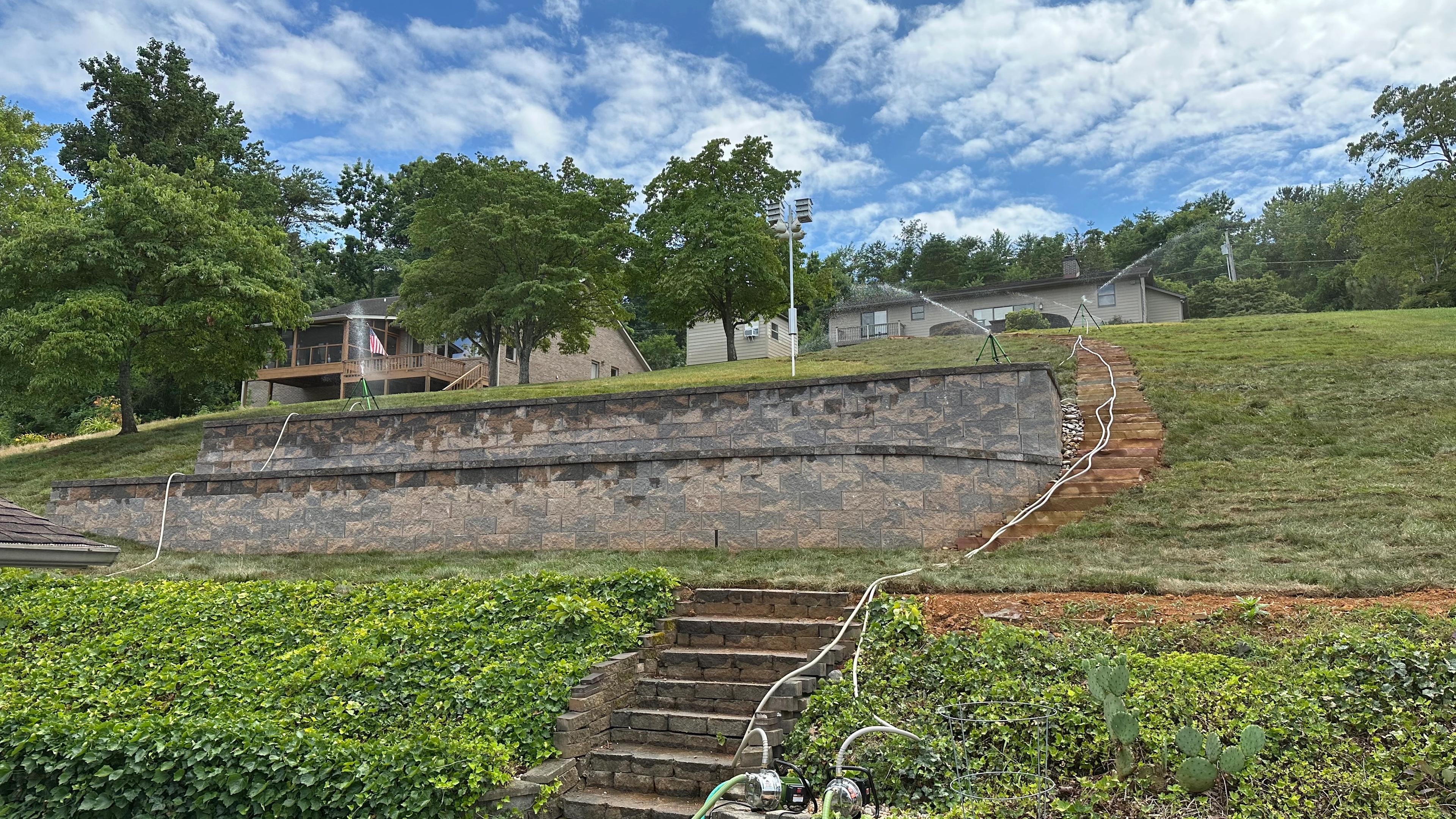
Retaining walls are one of those projects where the “right” choice depends less on what looks good in a photo and more on what your slope is doing during a Loudon downpour. If you are comparing a boulder retaining wall vs block, you are already asking the right question, because both can perform well in East Tennessee, but they solve problems in different ways.
Here in Loudon County and the surrounding area, we see a mix of red clay, rockier cuts, and neighborhoods built on rolling grades. Add heavy rain events, occasional freeze-thaw cycles, and tight build sites near driveways or patios, and your wall choice becomes a structural decision, not just a style decision.
In this guide, we will walk you through retaining wall options in Loudon, TN with a true side-by-side comparison of natural boulder wall builds and segmental block wall systems. We will cover cost drivers, drainage, lifespan, typical failure points, and the best use cases for each, so you can request quotes with confidence and avoid expensive surprises.
Quick comparison: boulder vs segmental block retaining walls
Both wall types can be excellent when they are designed for your site and installed with the right base, backfill, and drainage. The differences come down to engineering approach, appearance, access, and how precisely we can control grade.
Natural boulder wall (what it is and how it works)
Why homeowners like it:
- Natural, timeless look that fits East Tennessee landscapes
- Great for blending into wooded lots, lake-area properties, and rustic outdoor living spaces
- Can be forgiving visually, minor settlement is less noticeable
Where it shines in Loudon: We often recommend boulder walls where the yard already has natural stone, where you want a more organic edge to a planting bed, or where a slope needs stabilization without a “manufactured” look.
Segmental block wall (what it is and how it works)
Why homeowners like it:
- Clean lines and consistent finish
- Easier to integrate steps, corners, curves, and caps
- Predictable engineering for taller walls and tight spaces
Where it shines in Loudon: Block walls are often the best retaining wall for a slope when you need a precise grade change near a driveway, pool, patio, or when space is limited and you cannot build a wide, stepped-back footprint.
If you want to explore wall construction as part of a bigger outdoor project, our Hardscaping team designs walls alongside patios, steps, and drainage so everything works together.
Cost drivers in Loudon: what really changes the price
Homeowners often ask for a simple “boulder vs block cost” answer. In reality, retaining wall cost factors are usually driven more by site conditions and wall function than by the face material alone.
Here are the biggest price variables we see in Loudon, Lenoir City, and nearby neighborhoods.
1) Wall height and total square footage
Most contractors price retaining walls by face square footage, but height changes everything:
- Taller walls require deeper base prep and more backfill material.
- Taller walls are more likely to need reinforcement (especially for block systems).
- Taller walls increase drainage requirements and inspection or engineering needs.
Even a difference from 3 feet to 4 feet can shift the build approach, especially if the wall is holding back a driveway edge or creating a flat yard for outdoor living.
2) Access to the work area
Access is a major driver for both styles, but it affects them differently.
Boulder walls: Large boulders typically require equipment access for safe placement. If we cannot get a machine close to the wall line, labor and time go up quickly.
Block walls: Block is more “hand-carry friendly” in tight backyards, but it still requires base excavation, compacting, and moving aggregate. Poor access can still add significant cost.
In many Loudon neighborhoods with fenced backyards and narrow side gates, access planning is one of the first things we evaluate during a site visit.
3) Base prep and soil conditions (clay, rock, and water)
East Tennessee clay holds water and can become heavy and unstable when saturated. That is why base prep and drainage are non-negotiable.
- If we hit soft, wet clay, we may need to over-excavate and rebuild the base with compacted stone.
- If we hit shallow rock, excavation can slow down, but it can also provide a strong bearing surface once properly prepared.
If you suspect your yard needs broader grading fixes, it is worth reading our post on Kingston TN Yard Grading: Signs You Need Regrading because many “wall problems” start as “water and grade problems.”
4) Drainage plan and water management
In our region, drainage is often the difference between a wall that lasts decades and a wall that starts leaning in a few seasons. A real drainage plan can include:
- Free-draining gravel backfill
- Perforated drain pipe at the base
- Proper outlet location (daylight, pop-up emitter, or tie-in where allowed)
- Surface water control above the wall (swales, downspout routing)
This is why we treat retaining wall drainage as part of the wall design, not an optional add-on.
For a deeper explanation of what “done right” looks like, see Retaining Wall Drainage: Gravel, Pipe and Weep Holes Explained.
5) Engineering, permits, and surcharge loads
If a wall is near a driveway, structure, or supports a slope with extra load (called a surcharge), it may require a more engineered approach.
Common surcharge examples in Loudon:
- Driveways and parking pads above the wall
- Pools, hot tubs, or heavy patios near the wall edge
- Steep slopes where the upper yard funnels runoff toward the wall
If your project is in a jurisdiction that requires permits or engineering for certain heights or locations, plan for that in the budget and timeline. Requirements vary, and we always recommend confirming local rules early.
Drainage and performance on East Tennessee slopes
When homeowners ask us for the “best retaining wall for a slope,” we usually respond with another question: “Where is the water going during a heavy rain?” In Loudon, that question matters because intense storms can saturate clay fast. Water adds weight behind the wall and creates hydrostatic pressure, which is a common cause of bulging and failure.
What good retaining wall drainage looks like (for both types)
Regardless of whether you choose boulders or block, we look for these fundamentals:
- A stable, compacted base
- Proper excavation depth
- Compacted crushed stone base
- Level starting course or stone set line
- Free-draining backfill behind the wall
- Clean gravel directly behind the wall face
- Separation fabric where appropriate to limit soil migration
- A way for water to exit
- Perforated pipe at the base in many designs
- A planned discharge point that does not create a new erosion problem
- Surface water control above the wall
- Grading that prevents roof runoff and yard runoff from dumping directly behind the wall
If your property has persistent wet areas, pairing your retaining wall with targeted drainage solutions can protect the investment. Our Property Maintenance team also helps homeowners keep drainage outlets clear and landscapes functioning over time.
How boulder walls handle water
Boulder walls can be excellent in wet conditions when built correctly because:
- The wall face can “breathe” and allow incidental water to escape through joints.
- The mass of the boulders resists movement.
However, boulder walls are not immune to failure. If water is trapped behind the wall due to poor backfill or no outlet, pressure still builds, and the wall can shift over time. We also watch for soil washing out through gaps if the backfill is not properly separated and compacted.
How segmental block walls handle water
Segmental block walls are engineered systems, and when installed with proper drainage, they perform extremely well.
Key points we pay attention to:
- Correct base depth and compaction (settlement is the enemy of straight lines)
- Drain pipe placement and outlet planning
- Proper gravel zone behind the blocks
- Geogrid reinforcement where needed
Block walls can look “perfect” on day one, but they are less forgiving of shortcuts. A small base or poor compaction can show up as a visible dip, tilt, or separated cap line.
Lifespan, durability, and maintenance in Loudon’s climate
Homeowners are right to ask about lifespan. A retaining wall is not a seasonal upgrade, it is structural landscaping.
Expected lifespan (when built correctly)
- Segmental block wall: Often 30 to 50 years or more, depending on the product quality, installation, and drainage.
- Natural boulder wall: Often decades as well, with the advantage that natural stone does not degrade like some manufactured finishes can.
The bigger variable is not the material. It is whether the wall is designed for the site and whether water is managed.
Freeze-thaw and movement
East Tennessee does not have the same deep freeze as northern climates, but we do get freeze-thaw cycles that can:
- Expand water in the soil
- Cause minor heaving in poorly compacted bases
- Loosen caps or shift stones if drainage is inadequate
This is one reason we emphasize compacted base stone and drainage behind the wall face.
Maintenance differences
Boulder walls:
- Generally low maintenance
- May collect leaves and debris in joints, which can support weed growth
- Can be paired with groundcovers to soften the look and reduce erosion
Block walls:
- Low maintenance, but caps and joints should be checked periodically
- Efflorescence (a white haze) can appear on concrete products in humid climates, usually cosmetic
- We recommend keeping downspouts and surface runoff from concentrating behind the wall
If you already have an older wall showing signs of movement, it is worth learning the warning signs early. Our team often references issues like bulging, leaning, and drainage failures when evaluating repairs.
Best use cases in Loudon: when to choose boulders vs block
If you are comparing retaining wall options in Loudon, TN, here is how we typically guide homeowners during the consideration stage.
When a natural boulder wall is the better fit
Choose a natural boulder wall when:
- You want a natural, high-end look that blends into the landscape
- Your wall is relatively low to moderate height and can be built with a stable footprint
- Your property has a wooded, lake, or rural feel where stone looks “native”
- You want a wall that pairs well with planting pockets and organic curves
Real-world Loudon scenario we see often: A backyard that slopes toward a fire pit area or patio, where the homeowner wants terraced planting beds and a natural stone look. A boulder wall can create a relaxed, outdoor living vibe and handle minor grade changes gracefully.
If you are also planning a fire feature, our comparison post can help you think through layout and space planning: Fire Pit vs Outdoor Fireplace: Choosing the Right Outdoor Fire Feature for Tennessee Yards.
When a segmental block wall is the better fit
Choose a segmental block wall when:
- You need a taller wall or a wall that must be engineered with reinforcement
- Space is tight and you cannot build a wide, stepped-back footprint
- You need clean lines near a driveway, walkway, or patio edge
- You want consistent heights, corners, steps, or integrated seating walls
Real-world Loudon scenario we see often: A side yard with limited space where erosion is cutting into usable lawn area. A block wall can create a crisp edge, reclaim flat space, and integrate drainage behind the wall in a predictable way.
If you are weighing whether a wall is even necessary, you may also like Retaining Wall vs Regrading in Loudon: Which Fixes Erosion? before you commit to a specific material.
Design details that affect looks and function
Once you pick boulder vs block, the next step is dialing in the details that make the wall feel intentional and last long-term.
Wall batter and setbacks (the subtle stability detail)
Most retaining walls should lean slightly back into the slope. This is called batter or setback, and it helps the wall resist the pressure of the soil behind it.
- Boulder walls often achieve this naturally through stone placement and stepping back each course.
- Segmental block walls use built-in setbacks based on the block design.
If a wall looks perfectly vertical on a slope, that can be a red flag unless it is engineered for that condition.
Caps, coping, and finished edges
- Block walls typically use a cap unit for a clean finish and comfortable top edge.
- Boulder walls can be finished with flatter stones at the top, or left more natural depending on the look you want.
If the wall will be near a seating area, steps, or a patio, we think about comfort, safety, and how people will move through the space.
Curves, corners, and transitions
- Boulder walls are great for sweeping curves and natural transitions.
- Block walls are excellent for precise curves, tight corners, and consistent height changes.
In many Loudon outdoor living projects, we also coordinate wall lines with planting beds. If you want help with plantings that handle clay soil and slope conditions, our Landscaping services can build a plan that supports the wall instead of fighting it.
What we look at during a Loudon retaining wall site visit
When homeowners call us for quotes, we do not just measure the length and height. We evaluate the conditions that determine whether the wall will perform.
Here is a simplified version of our checklist:
- Slope shape and runoff paths: Where does water come from, and where does it go?
- Soil type and compaction risk: Clay, fill dirt, or rocky subgrade?
- Existing drainage: Downspouts, sump discharge, swales, or low spots
- Loads near the wall: Driveways, structures, trees, patios
- Access and staging: Where can materials and equipment safely go?
- Aesthetics and long-term use: Do you want planting pockets, a clean modern look, or a natural feel?
We also talk through how you plan to use the space. A wall that holds back a slope behind a patio needs different detailing than a wall that simply defines a planting bed.
If you are in Loudon and want local context from a team based nearby in Kingston, we serve the area through our Loudon service page and can help you compare options based on real site conditions.
Red flags to avoid when comparing retaining wall quotes
In the consideration stage, it is easy to compare quotes by price alone. We recommend comparing scope and details instead.
Watch for these red flags:
- No mention of drainage details (pipe, gravel, outlets)
- Vague base prep language like “level ground” without excavation and compaction specifics
- No plan for where water will discharge
- A very tall wall proposed with no reinforcement discussion
- No conversation about access, staging, and protecting your property
Conclusion: choosing the right wall for your Loudon slope
When it comes to boulder retaining wall vs block, the best choice depends on your slope, space, drainage needs, and the look you want for your outdoor living area. Boulder walls bring a natural, high-end feel and can be an excellent fit for organic landscapes. Segmental block walls offer precise engineering, clean lines, and are often the smarter option for taller walls or tight spaces.
In Loudon, we always start with water. If runoff and drainage are handled correctly, both wall types can deliver long-term performance and curb appeal.
If you are ready to compare retaining wall options on your property, contact us through our Hardscaping services. We will evaluate your slope, soil, and drainage, then recommend a wall design that fits your budget and how you actually use your yard.


