

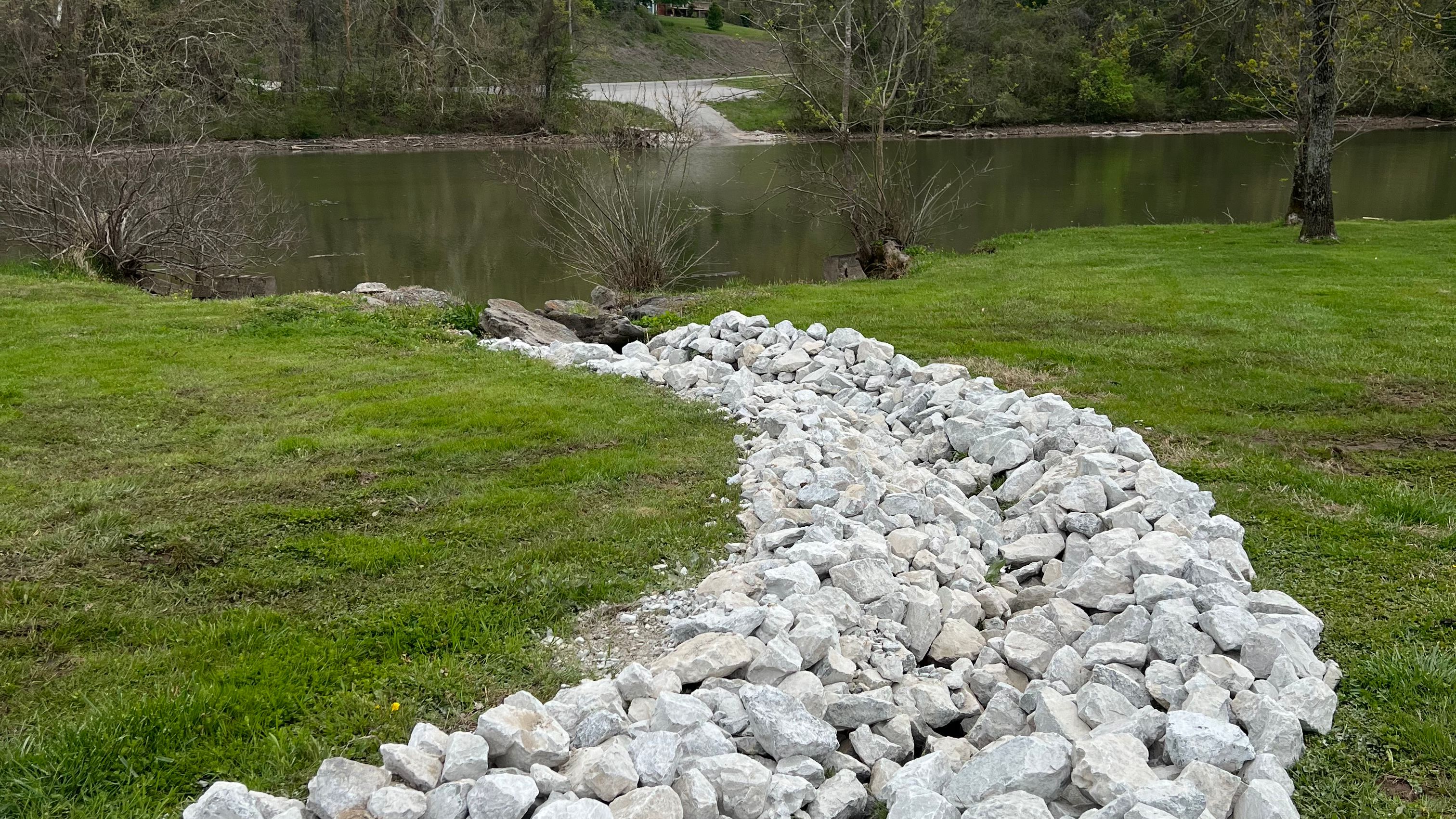
If you live in Loudon, Lenoir City, Kingston, or anywhere around East Tennessee, you already know how fast a normal rain can turn into a downpour. One week your yard looks fine, the next week you have soggy patches, muddy ruts, water pushing mulch into the driveway, or runoff cutting a channel across the slope.
When homeowners ask us about French drain vs dry creek bed options, they are usually trying to solve the same problem, get water away from the house and out of the yard without creating a maintenance headache. Both are proven yard drainage solutions in East Tennessee, but they work differently, they fit different site conditions, and the long-term results depend heavily on good design and correct installation.
In this guide, we will compare French drains and dry creek beds for heavy East TN rain, including cost ranges, where each works best, maintenance needs, and a practical way to choose based on slope, soil (including clay), and runoff patterns.
Why East Tennessee drainage problems are different
East Tennessee yards often combine three factors that make stormwater runoff control tricky.
First, our rain events can be intense. When the ground is already wet, a heavy storm produces more surface runoff than infiltration. Second, many neighborhoods in and around Loudon, Lenoir City, and Roane County have clay-heavy soils. Clay holds water and drains slowly, so water tends to perch near the surface and create that spongy feeling underfoot.
Third, a lot of properties are not flat. Even a “gentle” backyard slope can concentrate flow, especially where downspouts dump water into a bed or where two swales meet. Over time, that concentrated water can:
- Undermine patios and walkways
- Push soil against foundations
- Create standing water that kills turf
- Erode slopes and expose roots
- Flood low spots near fences or sheds
French drain vs dry creek bed, what each one actually does
What a French drain is (and what it is not)
- A trench with a consistent slope
- Washed gravel
- A perforated drain pipe (usually 4-inch)
- Filter fabric to reduce sediment intrusion
- A discharge point (daylight outlet, pop-up emitter, or connection to an approved storm system)
The goal is to collect water in the soil and move it to a safe exit point. In East Tennessee, we often use French drains to relieve saturated areas, intercept hillside seepage, and protect structures.
What a dry creek bed is (and what it is not)
- A shallow channel shaped like a natural stream
- Landscape fabric (in many, but not all, designs)
- A base layer of smaller stone
- Decorative river rock and larger “armor” stone to resist movement
- Optional step-down pools, check stones, or small drop structures
The goal is to give runoff a place to go so it does not carve its own path through turf or planting beds. A properly built creek bed can be both functional and attractive, which is why many homeowners consider dry creek bed installation Tennessee projects as a landscape upgrade, not just a fix.
Cost ranges in East Tennessee (what typically drives the price)
Homeowners often search French drain installation cost Tennessee because pricing varies widely. That is normal, because drainage is site-specific. Here are realistic ranges we see around Kingston and nearby communities.
French drain cost range
In East Tennessee, a professionally installed French drain commonly falls in the range of:
- $25 to $60 per linear foot for many straightforward residential runs
- $60 to $100+ per linear foot when access is tight, depth is significant, or the outlet requires more work
What changes the cost:
- Outlet complexity: Daylighting on a slope is often simpler than routing to a pop-up in a flat yard.
- Depth and trenching conditions: Roots, rock, and utilities slow excavation.
- Soil and sediment load: Clay soil drainage often needs better fabric, cleaner stone, and careful backfill.
- Restoration: Re-seeding, sod replacement, or repairing beds and edging.
Dry creek bed cost range
- $20 to $50 per linear foot for many standard creek beds
- $50 to $120+ per linear foot for wider channels, premium stone, larger boulders, or engineered drops
What changes the cost:
- Width and depth: Wider and deeper means more excavation and more stone.
- Rock type and size: River rock, cobble, and boulders vary in material cost and delivery.
- Erosion control details: Check stones, underlayment layers, and transitions to existing swales.
- Aesthetic integration: Planting pockets, edging, and tying into existing Landscaping.
If you are comparing bids, make sure both proposals define the outlet path and how the contractor handles erosion at the discharge point. That is a common place where “cheap” drainage becomes expensive later.
Where each option works best in Loudon, Lenoir City, and nearby areas
Best uses for a French drain
We tend to recommend a French drain when the problem is below the surface or close to structures.
- Soggy yards with no obvious surface channel (water perches in clay and stays)
- Downspout and foundation saturation (when water is soaking the perimeter)
- Hillside seepage (wet areas that appear even when it has not rained recently)
- Protecting hardscapes like patios, walkways, and retaining walls
French drains can also be paired with hardscape work. For example, when we build patios, walls, or grading transitions as part of our Hardscaping, we often incorporate drainage behind walls or along edges to prevent hydrostatic pressure and settlement.
Best uses for a dry creek bed
- Runoff coming off a driveway or roof valley and cutting through the yard
- Side-yard swales that turn into muddy trenches
- Slope erosion where grass cannot hold the soil
- Areas where you want a functional feature that looks intentional
In neighborhoods with rolling lots, we frequently see a pattern where water concentrates between houses. A creek bed can direct that flow to a safe outlet while keeping the area usable and easier to maintain.
If your main issue is “water racing” during storms, a creek bed is usually more direct than trying to bury a solution.
How to choose based on slope, soil, and runoff patterns
Drainage is not one-size-fits-all. Here is the framework we use on site visits around Kingston and the greater area.
Step 1, identify the type of water you are dealing with
Ask yourself what you see during and after storms.
- Surface runoff: You see water moving, channels forming, mulch washing, or water sheeting over the lawn.
- Subsurface saturation: You see soggy turf, squishy ground, or standing water that lingers long after the rain.
Surface runoff points toward a dry creek bed or surface swale. Subsurface saturation points toward a French drain, soil improvement, or both.
Step 2, check slope and the feasibility of an outlet
Both systems need a place to send water.
- If you have a clear downhill path to daylight, a French drain can work very well.
- If you are on a flat lot with no fall, a French drain may require a pop-up emitter, a larger collection area, or a different approach entirely.
For a dry creek bed, slope helps move water, but too much slope can increase velocity. In steeper areas, we often slow water down with wider sections, larger stone, or check features.
Step 3, consider clay soil behavior
Clay soil drainage issues are common in East Tennessee. Clay does not absorb water quickly, so you get more runoff and longer saturation.
- A French drain can relieve saturation, but only if it has proper slope and clean stone around the pipe. In clay, we are careful about fabric use and sediment control so the system does not clog.
- A dry creek bed handles clay well because it accepts that water will run on the surface, then moves it safely. It also reduces erosion because the rock armors the channel.
Step 4, match the solution to your yard use and aesthetics
If the area is a play space or you want uninterrupted lawn, a French drain is easier to hide once restored.
If you would rather turn a problem area into an intentional landscape element, a creek bed can look like a natural feature, especially when paired with boulders, ornamental grasses, and native plants.
Step 5, look for “stacked problems” that need a combined approach
Many properties need more than one tactic. A common combination is:
- French drain to intercept groundwater or relieve a soggy zone
- Dry creek bed to carry roof and slope runoff to the outlet
This is often the most reliable stormwater runoff control, because it addresses both water sources.
For a real-world example, we often see homeowners in Loudon dealing with a soggy backyard and a visible runoff path from a downspout. In those cases, a short French drain run near the wet area plus a creek bed for the downspout discharge can solve the issue without regrading the entire yard. If that scenario sounds familiar, our related post, How to Fix a Soggy Yard in Loudon Without Regrading Everything, walks through additional options we evaluate.
Maintenance and longevity, what you are signing up for
French drain maintenance
What we recommend homeowners plan for:
- Check the outlet after major storms: Make sure water is discharging and the outlet is not buried.
- Keep sediment out: Avoid washing soil into the area, and keep mulch from migrating into surface inlets.
- Watch for root intrusion: Rare, but possible near aggressive trees.
- Avoid heavy compaction over the trench: Especially right after installation.
Common failure points we see when drains are installed incorrectly:
- No slope or an outlet that sits underwater
- Using non-washed gravel that clogs with fines
- Skipping fabric where it is needed, or wrapping fabric incorrectly
- Tying multiple downspouts into a small perforated line without adequate capacity
Dry creek bed maintenance
Creek beds are easy to understand because you can see them. Maintenance is mostly about keeping the channel open and stable.
Typical upkeep includes:
- Leaf and debris cleanout in fall and after storms
- Re-setting displaced stones after unusually heavy rain
- Weed control in rock, usually with spot treatment or hand pulling
- Edge touch-ups if turf creeps in
Longevity is excellent when the bed is sized correctly. Problems happen when the creek bed is too narrow for the volume of water, or when the stone is too small and gets pushed downstream.
If you already invest in ongoing care, our Property Maintenance team often helps homeowners keep drainage features clear, especially before the rainy seasons when small clogs become big headaches.
Design details that matter (and why “DIY drainage” often underperforms)
We are all for informed homeowners, but we are also honest about what causes drainage projects to fail. The difference between “it looks good” and “it works in a six-inch rain” is usually in the details.
Sizing for real storms
Drainage features should be sized for the roof area, slope length, and how water concentrates. A small 4-inch pipe can handle a lot when installed correctly, but not if multiple downspouts and a hillside are feeding it with no cleanouts and no outlet protection.
Managing transitions and discharge points
Where water exits matters as much as how it travels.
- French drains need a protected outlet so it does not erode the downslope.
- Creek beds need a stable end point, such as a broad, armored spreader area, a natural swale, or another approved drainage path.
In many East Tennessee neighborhoods, you also need to be mindful of not sending concentrated runoff onto a neighbor’s property. If you are unsure, check local guidance and HOA rules. When in doubt, we design drainage that stays on your property and discharges safely.
Protecting hardscapes and structures
Water and hardscapes must be designed together. If you are dealing with settling pavers, washed-out gravel, or muddy edges along a patio, drainage is often part of the fix.
If you are planning a walkway or patio update at the same time, it helps to consider drainage early. Our post Gravel vs Pavers for East TN Walkways: Pros, Cons, Costs touches on how surface choices affect water movement and maintenance.
A quick decision guide (what we typically recommend)
Here is a practical way to narrow down your choice before you call a contractor.
Choose a French drain when
- The yard stays wet for days after rain
- Water seems to come from the hillside or under the surface
- You want the solution mostly hidden
- You have a reliable outlet path with enough slope
Choose a dry creek bed when
- You can see water flowing and it is causing erosion
- Downspouts dump water across turf or beds
- You want a feature that looks intentional
- You need to move water across the property without burying everything
Consider a combined system when
- You have both surface flow and soggy zones
- The problem changes seasonally (winter saturation plus summer downpours)
- Multiple sources feed the same low spot
If you are specifically searching for Loudon TN drainage solutions, we see these combined systems work well on lots with clay soil, moderate slopes, and concentrated downspout discharge.
Conclusion
When it comes to French drain vs dry creek bed choices in East Tennessee, the right answer depends on what kind of water you are managing. French drains are usually best for subsurface saturation and protecting foundations and hardscapes. Dry creek beds are ideal for visible stormwater runoff control and erosion, and they can add a clean, natural look to the landscape.
If you are in Kingston or nearby areas like Lenoir City or Loudon, we can help you evaluate slope, soil, and runoff patterns and recommend a drainage plan that actually holds up to our heaviest rains. When you are ready, explore our Landscaping and Hardscaping services, and reach out to schedule a site visit.


