

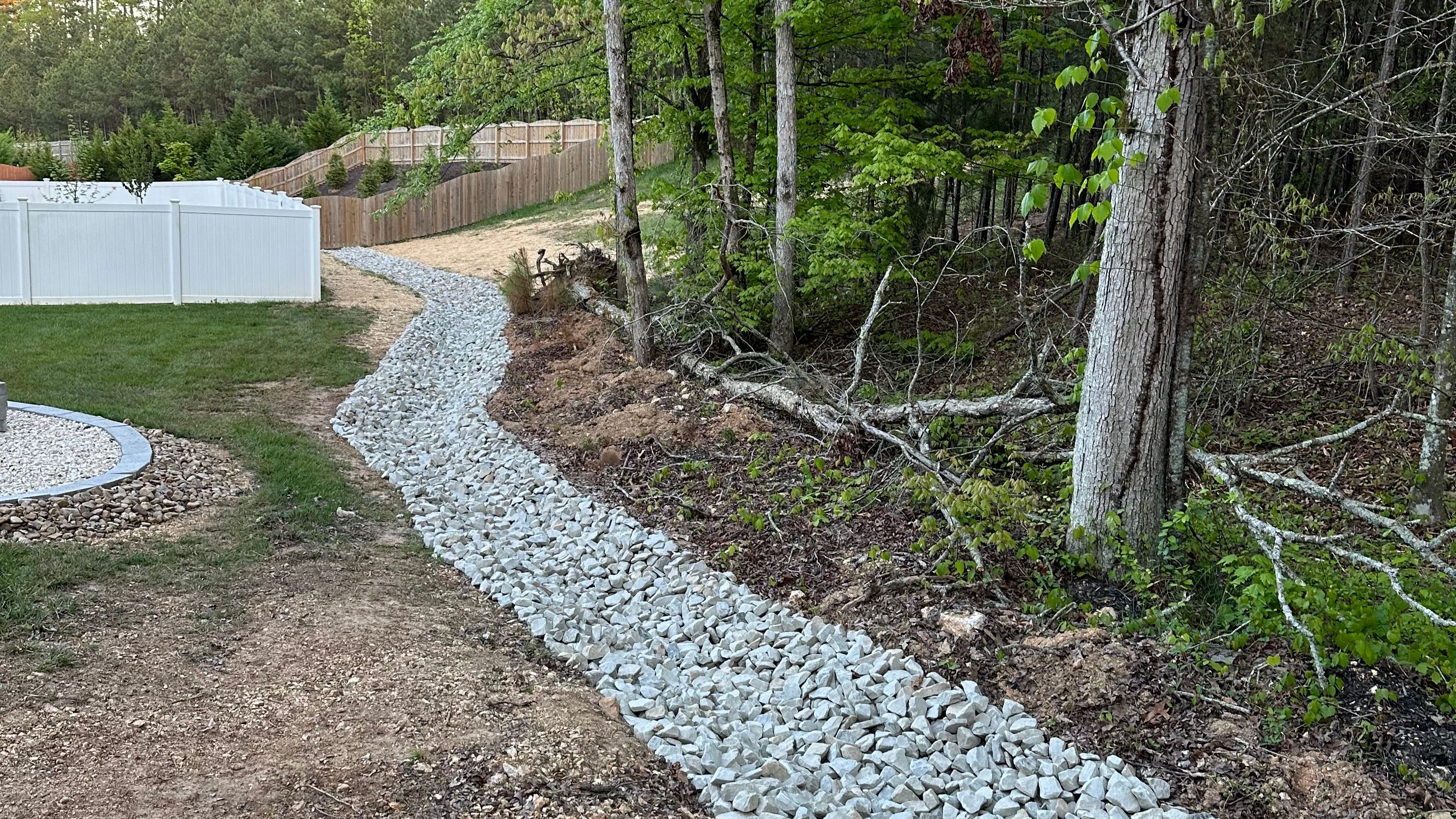
In this guide, we are sharing practical, less-invasive soggy yard solutions we use for homeowners who want to fix standing water in Loudon TN without regrading everything. We will walk through the most common causes, then cover targeted fixes like downspout routing, French drains and French drain alternatives, dry creek bed landscaping, rain gardens that fit our regional conditions, and soil amendments that actually help. Along the way, we will point out what you can DIY, what usually needs a pro, and how to choose the right approach for your property.
Why yards stay soggy in Loudon (and why regrading is not always the answer)
Standing water is usually a symptom of one or more issues happening at the same time. In Loudon, we commonly run into a mix of clay-heavy soils, shallow rock in some areas, and lots of runoff from roofs, driveways, and neighboring lots. Add compacted lawns from construction traffic or years of mowing on wet ground, and water has nowhere to go.
Here are the most common reasons we find when diagnosing wet yards:
- Roof runoff is dumping too close to the house. One downspout can discharge hundreds of gallons during a storm. If it empties beside the foundation or into a low spot, you get pooling.
- The yard has a "bowl" effect. Small depressions collect water even if the rest of the yard drains fine.
- Compacted soil blocks infiltration. Clay can absorb water, but compacted clay sheds it.
- Hard surfaces concentrate flow. Driveways, patios, and walkways accelerate runoff and can send it straight into turf.
- Subsurface water is moving through the property. In some neighborhoods, groundwater or hillside seepage shows up as a wet stripe across the yard.
Full regrading can work, but it is not always feasible. You might have fences, mature trees, established beds, irrigation, or tight setbacks. Sometimes you only need to intercept and redirect water at a few key points, which is faster, less disruptive, and more budget-friendly.
When we evaluate a drainage plan, we look at three goals:
- Keep water away from structures (foundation, crawlspace vents, retaining walls).
- Move water to a safe discharge point (a swale, a wooded edge, a street inlet where permitted, or another approved outlet).
- Improve the soil and surface so water can soak in where it makes sense.
If you want help with a full site plan that balances drainage with curb appeal, our Landscaping team builds solutions that match the way East Tennessee yards actually behave.
Step 1: Identify the source of the water before you install anything
Before you spend money on pipe, gravel, or plants, take one rainy day to gather evidence. This step alone prevents a lot of "we installed a drain and it still pools" frustration.
A simple 30-minute drainage check we use
Grab a notepad and walk your yard during a steady rain or right after.
- Watch downspouts. Where does each one discharge, and does it create a trench or puddle?
- Look for flow lines. You will often see water moving along the edge of a driveway, fence line, or bed.
- Mark the lowest points. These are your collection zones.
- Note soggy duration. If water is gone in 2 to 4 hours, you may need soil improvement more than piping. If it sits 24 hours or more, you likely need conveyance (a way to move it).
Quick tests that tell you a lot
- Screwdriver test for compaction: If you cannot push a screwdriver 4 to 6 inches into moist soil, compaction is part of the problem.
- Jar test for soil texture: Put soil in a jar with water, shake, and let it settle. A thick clay layer means infiltration will be slow without amendments.
- Gutter capacity check: Overflowing gutters can mimic a grading problem. If gutters spill, fix that first.
Step 2: Downspout routing, the fastest fix for standing water
If you are searching for "downspout drainage yard" fixes, start here. We routinely solve or dramatically reduce wet spots by controlling roof runoff. In a typical Loudon home, the roof can be the biggest single contributor to yard saturation.
What works well in Loudon yards
- Downspout extensions (temporary or permanent): Even a simple extension that moves water 6 to 10 feet away from the foundation can prevent pooling.
- Solid pipe to daylight: We often connect the downspout to a solid 4-inch pipe and run it to a safe outlet that slopes away from the house.
- Pop-up emitters: These are great for flat yards where you cannot "daylight" a pipe on a slope. They release water at the surface when the pipe fills.
Key installation details we see people miss
- Maintain continuous slope. A pipe that holds water becomes a sediment trap.
- Use solid pipe from the downspout. Perforated pipe right off the house can dump water into the soil next to the foundation.
- Add cleanouts. Leaves and roof grit happen. Cleanouts make maintenance realistic.
If you want us to bundle downspout routing with ongoing upkeep like seasonal cleanups and bed refreshes, our Property Maintenance service helps keep drainage features working year after year.
Step 3: French drains and smarter French drain alternatives
When a French drain is a good fit
- You have a defined wet zone or seep line.
- You can run the drain to a lower discharge point.
- The problem is subsurface water moving through the yard.
Typical components include a trench, filter fabric, washed gravel, perforated pipe, and a surface that either returns to turf or uses decorative stone.
When we recommend an alternative instead
If your yard is flat and has nowhere to discharge, a traditional French drain can fill up and do very little. In those cases, we look at:
- Area drains (catch basins) tied to solid pipe: Best for surface pooling in a specific low spot.
- Channel drains at hardscape edges: Great along a driveway, garage apron, or patio where sheet flow is predictable.
- Infiltration trenches (when soil allows): A rock-filled trench without an outlet can work only if infiltration rates are reasonable.
Common mistakes that cause French drains to fail
- No outlet or no slope. Water has to go somewhere.
- Wrong gravel. Pea gravel and mixed stone clog faster. Washed angular gravel is usually the right choice.
- No fabric or wrong fabric. Fabric keeps fines out of the gravel. Without it, clay migrates into the trench.
- Installing too shallow. A shallow drain may not intercept the water table or seep layer.
Because drainage often ties into patios, walkways, and retaining walls, we frequently design these systems alongside our Hardscaping work so the finished space looks intentional, not like an afterthought.
Step 4: Dry creek bed landscaping that actually moves water
Dry creek bed landscaping is one of our favorite ways to fix standing water in Loudon TN without making the yard look like a construction site. Done right, a dry creek bed is both drainage infrastructure and landscape design.
What a dry creek bed does well
- Carries stormwater across the yard in a controlled path.
- Prevents erosion by slowing and spreading flow.
- Adds curb appeal with natural stone, boulders, and plantings.
Design tips we use for East Tennessee rainfall
- Follow the natural flow line. Do not fight the yard. Use the route water already wants to take.
- Size it for real storms. In our area, you need to plan for downpours, not just light rain. Wider is often better than deeper for safety and appearance.
- Use a layered stone approach. Larger "armor" stone in the center line, smaller river rock along the sides, and occasional boulders to anchor the look.
- Add subtle drops and riffles. Small changes in elevation reduce speed and help with sediment.
Where dry creek beds shine in Loudon
We commonly install them:
- Along property lines where runoff enters from a neighbor.
- Between a patio and the lawn where sheet flow causes muddy edges.
- In side yards that act like a funnel from front to back.
Dry creek beds also pair well with downspout routing. You can daylight a downspout into the creek bed with a rock splash pad, then direct the flow to a safer outlet.
For homeowners who want drainage that looks like part of the landscape, this is often the best balance of function and aesthetics.
Step 5: Rain gardens for East Tennessee, built for clay and big storms
Choosing the right location
- It is at least 10 feet from the house (more is often better).
- It sits where runoff naturally collects, but not where groundwater is already at the surface.
- You can provide an overflow route for extreme storms.
Soil mix matters in Loudon
Native clay can be improved, but we rarely rely on clay alone. A typical approach is to amend with a blend that increases infiltration while still supporting plants. The exact recipe depends on the site, but the goal is consistent: create pore space so water can move down instead of sitting on top.
Plant selection, the make-or-break factor
We like using native and adaptive plants that tolerate both wet feet and summer heat. Think deep roots, tough stems, and plants that can handle occasional flooding.
If you want a plant list and layout ideas that do well in our region, our post on Native Plants for East TN: Low-Maintenance Landscape Picks is a great companion read.
Add an overflow so the rain garden never becomes the problem
In East Tennessee storms, every rain garden needs a safe overflow path. That can be a shallow swale to a wooded edge, a connection to a dry creek bed, or a discreet area drain that takes over when the basin is full.
Rain gardens are one of the best "yard drainage without regrading" strategies because they improve function while adding color and habitat.
Step 6: Soil amendments and aeration, the overlooked soggy yard solution
Sometimes the yard is not too low. It is just sealed shut. Compaction is extremely common in newer subdivisions around Loudon, and we see it in older lawns too, especially where kids play, dogs run, or equipment has been parked.
What helps and what does not
- Core aeration helps. It creates channels for water and oxygen. For many lawns, once in fall is good, and high-traffic lawns may benefit from spring plus fall.
- Topdressing with compost helps. A thin layer worked in over time improves soil structure.
- Gypsum is situational. It can help certain clay issues, but it is not a universal fix. If you are not sure, focus on compost and aeration first.
- Sand alone usually does not help. Mixing sand into clay without the right ratios can create a concrete-like texture.
A practical approach we often recommend
For lawns that stay squishy but do not have obvious runoff issues:
- Core aerate.
- Topdress with compost.
- Overseed with the right grass for sun and shade.
- Adjust mowing height to reduce stress.
If you are also dealing with thin turf or bare spots, choosing the right grass matters because healthier roots improve infiltration. Our guide Best Grass for East Tennessee Lawns: Fescue vs Bermuda can help you match grass type to your conditions.
Soil improvement is not instant, but it is one of the most cost-effective fixes for minor standing water issues, and it supports every other drainage upgrade you install.
Step 7: Combine solutions for the best results (a realistic Loudon game plan)
Most persistent wet-yard problems are not solved with one product. They are solved with a simple system.
Here is how we commonly combine fixes for Loudon homeowners:
Scenario A: Backyard puddle near the patio
- Route two downspouts into solid pipe to a pop-up emitter.
- Install a small catch basin at the lowest point.
- Add a short dry creek bed section to carry overflow away from the patio edge.
Scenario B: Side yard stays wet and mossy
- Core aerate and topdress to address compaction.
- Add a shallow swale or dry creek bed to intercept runoff from the front.
- If needed, add a French drain segment with a clear outlet.
Scenario C: Water coming from uphill neighbors
- Build an intercepting swale or dry creek bed along the property line.
- Use strategic plantings to stabilize soil.
- Add an overflow route that does not impact adjacent properties.
The goal is always the same: capture water where it concentrates, move it safely, and improve the soil so the yard rebounds.
If you are located in Loudon and want a plan that fits your lot, we can evaluate your drainage patterns and recommend the least disruptive path forward.
When to call a pro (and when DIY is fine)
Some drainage work is very DIY-friendly, especially if you are comfortable with shoveling and basic pipe connections. Other situations deserve professional design and installation.
DIY is often fine for:
- Downspout extensions and splash blocks
- Cleaning gutters and correcting obvious overflow
- Small surface tweaks like filling minor depressions
- Core aeration (rental or service) and compost topdressing
Call a pro when:
- Water is moving toward the foundation or pooling near crawlspace vents
- You need to tie multiple drains together and maintain slope
- You are working near utilities, septic components, or irrigation lines
- You want drainage integrated into patios, walkways, or retaining walls
We are based in Kingston and work throughout the area, so we are familiar with the soils and storm patterns that make drainage tricky across this part of Tennessee.
Conclusion: You can fix a soggy yard without tearing up the whole property
If you are dealing with standing water, you do not have to jump straight to full regrading. The most effective "yard drainage without regrading" plans usually start with controlling roof runoff, then adding targeted collection and conveyance where water actually concentrates. From there, features like dry creek bed landscaping and rain gardens can turn problem areas into attractive parts of the yard, while soil amendments and aeration improve long-term performance.
If you want help choosing the right combination of soggy yard solutions for your property, reach out to us at Rock Solid. We can look at your downspouts, soil, and low spots, then recommend a practical plan that fits your budget and your yard. Explore our Landscaping and Hardscaping services, and if you are in Loudon, we would be glad to help you reclaim your lawn from the mud.


