

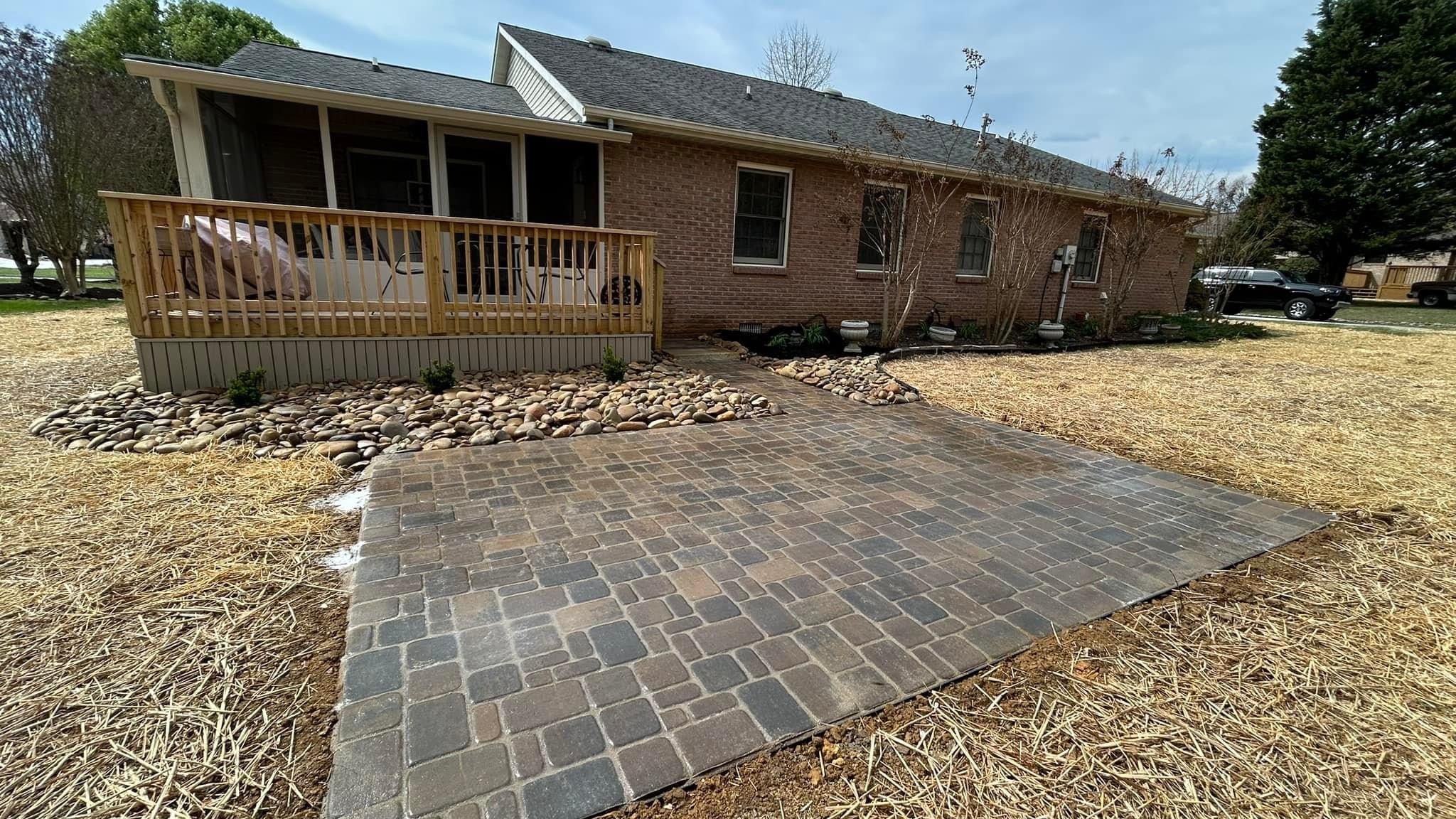
In East Tennessee, a paver patio is only as good as the base under it. Our mix of clay soils, heavy downpours, and winter freeze-thaw cycles can turn a “looks fine today” DIY patio into a wavy, settling mess within a season or two.
When we build patios around Kingston and across the Knoxville area, we treat the base like the real project, because it is. Pavers are the finish surface. The base is what controls drainage, prevents frost heave, and keeps edges locked so the field does not creep.
In this guide, we will walk you through a proven patio base preparation approach for East TN conditions, including how deep you should excavate, when geotextile fabric under pavers actually helps, crusher run vs #57 stone, and how to get paver base compaction right with the tools most homeowners can access. We will also call out the most common mistakes we see, especially on clay, slopes, and areas that take roof runoff.
Why East Tennessee patios fail (and why the base matters most)
Most paver problems we get called to look at are not “bad pavers.” They are base and drainage problems that show up as:
- Low spots that hold water after a storm
- Settling near edges, steps, or downspouts
- Lippage (one paver higher than the next)
- Washed-out joint sand and ants moving in
- Frost heave in winter followed by loosening in spring
East Tennessee soils are often clay-heavy, which means they hold water and drain slowly. Add our intense rain events and you can end up with a saturated subgrade. When that wet soil is loaded (patio furniture, foot traffic, sometimes even light vehicles for a driveway apron), it compresses unevenly. Then winter arrives. Freeze-thaw paver patio movement happens when water in the base or subgrade expands as it freezes, then relaxes when it thaws. Repeated cycles can lift sections and leave voids.
- Creates a stable, compacted platform that spreads loads evenly
- Moves water away (either through the system or across the surface)
- Locks the pavers together with proper edge restraint and jointing
If you are planning a full outdoor living space, our Hardscaping team builds these bases every week in Kingston, Knoxville, and surrounding towns. For DIYers, the steps below will help you build it like a pro.
How deep should a paver base be in East Tennessee?
The question we hear most is, “how deep should paver base be?” The right answer depends on three things: intended use, soil type, and drainage exposure.
A practical depth rule for East TN patios
For a typical residential patio (foot traffic, grill, furniture) in our area, we generally plan for:
- Excavation depth: about 7 to 10 inches below finished paver height
- Base stone thickness (compacted): 4 to 6 inches
- Bedding layer: 1 inch of screeded bedding material
- Paver thickness: commonly 2 3/8 inches (varies by product)
That stack-up is why many patios end up around the 7 to 10 inch excavation range. If you are building on very firm, well-draining ground, you may land on the lower end. If you have soft clay, shade that stays wet, or roof runoff nearby, you should lean deeper and focus heavily on drainage.
When you should go deeper
Increase depth and base thickness when:
- The area is low and stays damp after rain
- You have heavy clay that pumps water when you walk on it
- The patio is near downspouts or a valley that concentrates runoff
- You are building a hot tub pad or a space that carries heavier loads
For heavier loads (like a driveway or parking pad), base design changes significantly. At that point, we recommend you treat it as a structural section and consider professional design and installation.
Do not “average” depth on a slope
Instead:
- Excavate to a consistent depth relative to your planned finished grade
- Build your base in compacted lifts
- Maintain a controlled surface pitch (more on that below)
If the patio ties into a yard with drainage problems, it is worth reading our drainage-focused comparison of solutions in French Drain vs. Dry Creek Bed for East TN Drainage.
Base material choices: crusher run vs #57 stone (and when to use each)
Stone selection is where a lot of patios either become bulletproof or become spongy. The keyword debate is real: crusher run vs #57 stone.
What “#57 stone” does well
#57 stone is a clean, angular gravel (typically around 3/4 inch) with very little fines. Because it is clean:
- It drains very well
- It is less likely to hold water in the base
- It is useful in drainage zones and as a leveling layer under certain applications
The downside is that clean stone does not “lock” as tightly as a well-graded material with fines. It can be compacted, but it tends to be more prone to shifting if used alone in a base that needs strong interlock.
What crusher run (or dense-graded base) does well
Crusher run (often called dense-graded aggregate) contains a mix of stone sizes plus fines. When compacted correctly, it:
- Locks together and creates a very stable base
- Resists rutting and movement
- Builds a strong platform for pavers
The tradeoff is drainage. Because it has fines, it can hold moisture longer than clean stone. In East Tennessee, that is not automatically a deal-breaker, but it means you must pay attention to slope, runoff, and keeping the subgrade from staying saturated.
Our practical approach for East TN conditions
For most patios in Kingston and nearby communities, a stable, dense-graded base is the workhorse. Where we see persistent water or clay that stays wet, we often combine strategies:
- Improve surface drainage (proper pitch and runoff routing)
- Use geotextile when conditions call for separation
- Consider a drainage layer or localized underdrain details when water is unavoidable
There is no one “magic stone” that fixes a poor plan. The best base is the one that matches the site.
Geotextile fabric under pavers: when it helps and when it is a waste
People often ask about geotextile fabric under pavers. The truth is, fabric is not required for every patio, but in East TN it can be extremely helpful in the right situations.
What geotextile is actually for
- It helps keep base stone from mixing into soft subgrade soils
- It reduces “pumping” where wet clay migrates upward into the base
- It can improve long-term performance in soggy or soft areas
Fabric is not a substitute for base thickness, compaction, or drainage.
When we recommend it in East Tennessee
Geotextile is worth using when:
- You have soft clay or silty soil that deforms when wet
- The site is low-lying or stays saturated
- You are building over disturbed soil (recent backfill, utility trenches)
- You are trying to prevent base contamination over time
When fabric can cause problems
Fabric can be misused. Common issues:
- Using landscape weed fabric instead of proper geotextile (wrong product)
- Wrapping fabric in a way that traps water with no exit path
- Assuming fabric replaces excavation depth or compaction
If you are unsure, it is better to keep the system simple and focus on correct excavation, base, and drainage rather than adding fabric without a plan.
Excavation and grading: the step that determines everything
If we could watch one step on every DIY patio build, it would be excavation and grading. This is where you set elevation, pitch, and drainage behavior.
Start with a clear finished height plan
Before digging, decide:
- Finished patio height relative to doors and thresholds
- Where water should flow during a heavy storm
- How you will tie into existing grade, beds, and walkways
In our region, we regularly see patios that end up too high and push water toward the house. If you are near a foundation, consider local best practices for keeping water moving away from the structure.
Build in slope on purpose
- About 1/8 inch per foot minimum
- Up to 1/4 inch per foot when you need stronger drainage
Slope should generally run away from the house and toward a safe outlet. The key is consistency. A patio can be sloped and still feel flat underfoot if it is uniform.
Deal with clay subgrade correctly
On clay, the subgrade can smear when wet. If you excavate after a rain, you may create a slick, sealed surface that does not drain.
What we do in the field:
- Avoid working saturated soil when possible
- Shape and compact the subgrade lightly to reduce future settlement
- Use separation fabric when the clay is soft and wants to mix
If you are managing broader property drainage issues, our Property Maintenance team often helps homeowners correct runoff patterns before they invest in hardscape.
Paver base compaction: tools, lifts, and a simple field test
Getting paver base compaction right is what keeps your patio from settling. Most failures we see are tied to one of these: compacting too thick at once, compacting the wrong material, or skipping compaction near edges.
Use the right compactor
For most patios, a plate compactor is the right tool. Hand tampers are fine for tiny areas and edges, but they are not realistic for an entire patio if you want long-term stability.
If you are renting, ask for a plate compactor appropriate for gravel base. If you are compacting near a house, take care around utilities and avoid vibrating against foundation walls.
Compact in lifts, not all at once
- Place base material in 2 to 3 inch lifts
- Compact each lift thoroughly before adding the next
- Lightly moisten dry material (not soaked) to help fines bind
Trying to compact 6 inches in one lift often leaves the bottom loose. That loose layer settles later, and you see dips and lippage.
A simple compaction check DIYers can use
We use experience and feel, but here are practical checks:
- After compaction, your footprints should be minimal or none
- A screwdriver should not easily plunge deep into the base
- The surface should feel firm, not “crunchy” or shifting
If the base still moves under a plate compactor, you may be on soft subgrade that needs stabilization, more excavation, or separation fabric.
Bedding layer and screeding: keep it thin and consistent
The bedding layer is not where you fix grade problems. It is a thin, uniform layer that allows pavers to seat evenly.
Keep bedding at about 1 inch
We aim for:
- About 1 inch of bedding material after screeding
- A smooth, consistent plane that matches your final pitch
Choose bedding material based on your system
Depending on the paver manufacturer and whether you are using traditional joint sand or polymeric sand, bedding recommendations can vary. Follow product specs when applicable.
If you are comparing surface options and long-term durability, our local breakdown in Paver Patio vs. Concrete Patio in Knoxville: What’s Best? provides a helpful decision framework.
Edge restraint and joints: the “lock” that keeps everything tight
Even with a perfect base, pavers can spread if edges are not restrained.
Use real edge restraint
For patios, we typically use a purpose-made edge restraint system that is staked into the compacted base. The goal is to prevent lateral movement.
Skipping edge restraint is one of the fastest ways to get:
- Gaps opening at the perimeter
- Joint sand loss
- Wavy border lines
Compact pavers and fill joints correctly
After laying pavers:
- Run the plate compactor over the surface (with a protective pad if required)
- Sweep joint sand into the joints
- Compact again
- Top off joints until they stay full
For polymeric sand, follow the manufacturer’s wetting instructions exactly. Overwatering can wash binder out. Underwatering can leave it weak.
Freeze-thaw paver patio protection: drainage beats “deeper” every time
In East Tennessee, freeze-thaw damage is usually a water problem first. If water is not lingering in the base or subgrade, frost heave risk drops dramatically.
What matters most for freeze-thaw
- Keep the patio pitched to shed water
- Prevent roof runoff from dumping onto the patio edge
- Avoid trapping water with solid borders that have no outlet
- Use proper compaction so voids do not form and fill with water
We see the worst heave where:
- Downspouts discharge at the patio corner
- Gutters overflow in heavy rain
- The patio is built in a low spot with no drainage plan
If your yard already struggles with standing water, fix that first. A patio should not be a band-aid for drainage.
Common mistakes we see in Knoxville-area DIY patio bases
Here are the big ones we correct most often in Roane County, Lenoir City, and Oak Ridge:
1) Not excavating enough (or not removing organic soil)
Topsoil, roots, and organic fill compress over time. If you build on it, you are building on future settlement.
2) Using the wrong stone, or mixing random materials
3) Skipping compaction near edges and corners
Edges are where movement starts. Compact thoroughly and install edge restraint on a firm base.
4) Trying to fix grade with thick bedding sand
Bedding is for minor adjustment, not for building structure.
5) No plan for water
If water is flowing toward the patio, across it, or pooling at the edge, the base will suffer. In our climate, repeated saturation is the enemy.
A realistic DIY build sequence (the version that holds up)
If you want a simple checklist that matches how we think about long-lasting installs, use this sequence:
- Layout and elevations: mark finished height and slope
- Excavate: remove topsoil and dig to planned depth
- Prep subgrade: shape, lightly compact, add geotextile if needed
- Base stone: install in 2 to 3 inch lifts, compact each lift
- Screed bedding layer: keep it about 1 inch, consistent pitch
- Lay pavers: maintain straight lines, consistent gaps
- Compact and joint: compact, sweep sand, compact again, top off
- Edge restraint: install and secure, then finish borders and transitions
If you want the project handled end to end, our Hardscaping crews build patios designed for East Tennessee rainfall and winter conditions.
Conclusion: build the base for East TN weather, not just for today
If you remember three things, make them these: excavate deep enough to remove organics and make room for a real base, choose base materials intentionally (not randomly), and compact in lifts while maintaining consistent slope for drainage. Add geotextile fabric under pavers when the subgrade is soft and likely to mix, and never ignore roof runoff and low spots.
If you would like a site-specific recommendation, we are happy to help. Reach out through our Landscaping or Hardscaping services, and we can look at your soil, drainage, and layout to make sure your patio base is built to last in East Tennessee.


