

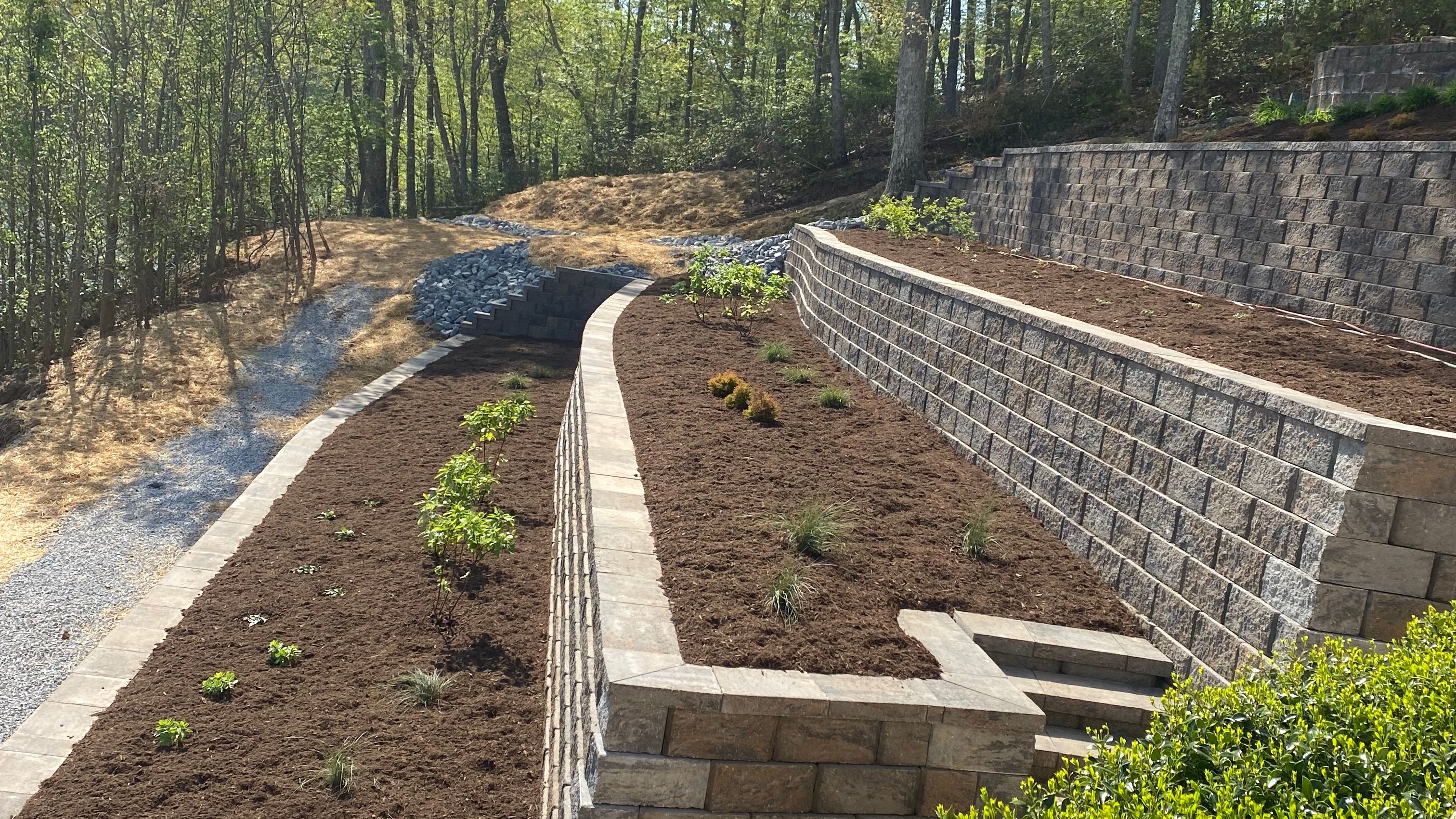
Retaining walls do a lot of quiet work in Oak Ridge. They hold back heavy soil, manage slope runoff, and protect patios, driveways, and foundations from erosion. When they start to fail, the damage is rarely just cosmetic. A small bulge can turn into a sudden collapse after a week of hard rain, and a little water behind the wall can become a constant drainage problem that softens soil and pushes blocks out of line.
If you are searching for retaining wall repair in Oak Ridge TN, you are probably seeing early warning signs and wondering how serious they are, and whether you are looking at a minor fix or a full rebuild. In this guide, we will walk through the most common signs of retaining wall failure, why they happen in East Tennessee conditions, and what repair options actually work, from drainage retrofits to partial rebuilds.
We build and repair walls across the Oak Ridge area and surrounding communities, and we have seen the same patterns repeat. Most failures come down to three things: water, soil pressure behind retaining wall sections, and construction details that were skipped or undersized. The good news is that catching problems early often keeps the repair scope smaller, safer, and more affordable.
Why retaining walls fail in Oak Ridge (and why it can happen fast)
Oak Ridge sits in a part of East Tennessee where rainfall, clay-heavy soils, and rolling terrain create ideal conditions for retaining wall stress. Even a well-built wall has to deal with changing moisture levels and seasonal movement. When a wall is older or was built without modern best practices, those stresses show up as visible damage.
Here are the most common local failure drivers we see:
- Poor drainage behind the wall. Water is the biggest enemy of most segmental block and timber walls. Saturated backfill gets heavier and increases lateral force. It also washes fines into drain stone, clogging it over time.
- Clay soils that hold water. Many Oak Ridge properties have dense soils that drain slowly. That means water pressure builds behind the wall and stays there longer after storms.
- Freeze-thaw cycles. We do not get the deep freezes of northern climates, but we do get enough freeze-thaw swings to gradually shift blocks, especially when water is trapped behind the wall.
- Improper base or embedment. Walls need a compacted base and the correct amount of buried first course. If the base settles unevenly or the wall is not embedded enough, it starts to lean or step out.
- No geogrid reinforcement on taller walls. Many older walls over 4 feet were built as gravity walls without reinforcement. In real life, soil pressure behind retaining wall sections can exceed what a gravity wall can safely resist.
If you are in the Oak Ridge area and your wall is near a driveway, pool deck, or structure, these issues are more than a landscaping concern. They are a property safety concern.
Signs of retaining wall failure you should not ignore
Some wall problems are cosmetic. Many are not. The challenge is that walls often fail gradually until they do not, especially after a heavy rain event.
Bulging or bowing in the middle of the wall
What it usually means:
- Water is building behind the wall and increasing pressure
- Backfill was not properly compacted
- Drain stone is missing or clogged
- The wall lacks reinforcement (geogrid) for its height
Leaning or tilting forward
Common causes:
- Base settlement or inadequate base thickness
- Erosion at the toe of the wall
- Excessive soil pressure behind retaining wall sections due to saturation
- Added loads near the top (parking, heavy planters, sheds)
If you can place a level on the face and clearly see the tilt, it is time for a professional evaluation.
Cracked blocks, separated joints, or “stair-step” gaps
With block retaining wall repair, cracks can show up in the blocks themselves or as widening joints where blocks are pulling apart.
Look for:
- Vertical cracks through individual blocks
- Gaps opening between blocks
- Corners separating
- A “stair-step” pattern where one section has shifted outward
These are often symptoms of movement, not the root problem. Repairing the face without addressing drainage and base conditions usually means the cracks come back.
Sinking, dipping, or uneven top cap
If the top of the wall is no longer level, the base may be settling or washing out. This is common where downspouts dump near the wall or where surface water runs along the back edge.
- After a rain, look for channels of water that run toward the wall
- Check for soggy soil behind the wall line
- Look for washed-out soil at the bottom front edge
Water stains, mud seepage, or algae growth on the face
These are classic retaining wall drainage problems. If you see water weeping through joints, dark staining, or algae, the wall is acting like a dam.
In Oak Ridge, this often happens when:
- There is no perforated drain pipe at the base
- There are no weep holes (or they are blocked)
- Backfill is soil instead of clean drainage aggregate
Soil, mulch, or landscape beds slumping behind the wall
If the ground behind the wall is settling, it can indicate voids forming due to water movement, poor compaction, or washout. It also increases the chance of sudden movement because the wall loses predictable support.
Fence posts, railings, or structures near the wall shifting
This is a high-value clue. If a fence line above the wall starts to lean, or pavers near the top begin to separate, it often means the entire slope mass is moving, not just the wall face.
Why drainage is the make-or-break factor for wall repairs
If you take one idea from this post, let it be this: most retaining wall failures we repair in East Tennessee involve water management. Fixing the face of the wall without fixing drainage is like repainting a wet ceiling without repairing the roof.
Here is what proper retaining wall drainage typically includes:
- Drain stone zone directly behind the wall (clean, angular aggregate)
- Filter fabric separating soil from aggregate to reduce clogging
- Perforated drain pipe at the base, sloped to daylight or a proper outlet
- Surface water control above the wall (grading, swales, downspout routing)
In Oak Ridge neighborhoods, we often see downspouts or sump outlets dumping right behind a wall. That can overwhelm any wall over time. Redirecting roof runoff is frequently part of a lasting repair.
If you want a deeper comparison of drainage solutions we use in this region, see French Drain vs. Dry Creek Bed for East TN Drainage. Those same principles often apply around retaining walls.
Repair vs replace retaining wall: how we evaluate the best option
When we assess a wall, we look at:
- Wall height and loads. Taller walls and walls supporting driveways require more conservative decisions.
- Degree of movement. A minor lean is different from a wall that has displaced several inches.
- Drainage conditions. If there is no way to add drainage or daylight an outlet, replacement with a different design may be smarter.
- Base condition. If the base has washed out or was never built correctly, spot repairs may not hold.
- Material condition. Timber rot, crumbling mortar, or deteriorated blocks can make repair impractical.
As a rule of thumb:
- Good candidates for repair include localized bulging, failing corners, separated caps, or walls with known drainage issues that can be corrected.
- Better candidates for replacement include widespread leaning, multiple failure zones, walls built too steep without reinforcement, or walls that are undersized for height and soil conditions.
If you are budgeting, it also helps to understand what drives pricing. We break that down in Retaining Wall Cost in Oak Ridge: Factors That Change Price.
Retaining wall repair options that actually work
Not every wall needs the same solution. Below are the most common repair paths we use for retaining wall repair Oak Ridge TN projects, along with what they solve and where they fall short.
Drainage retrofit (when the wall is mostly stable)
Typical components:
- Add or replace perforated drain pipe at the base
- Excavate behind the wall in sections and install drain stone and fabric
- Improve surface grading and downspout routing
- Add properly placed outlets to daylight
Best for:
- Early-stage drainage symptoms (weeping, staining, soggy backfill)
- Minor movement where the wall is still mostly plumb
Limitations:
- If the wall has already lost structural alignment, drainage alone will not put it back.
Partial rebuild (targeted repair for localized failure)
Partial rebuilds are common when a corner, a 6 to 12 foot section, or a small area has failed due to a concentrated water source or a weak base.
What we do:
- Remove the failed section down to the base
- Rebuild the base to proper thickness and compaction
- Reinstall blocks, caps, and alignment
- Add drainage improvements behind that section
Best for:
- Localized bulges
- Small sections impacted by downspout discharge
- Damage from tree roots or vehicle impact
Limitations:
- If the rest of the wall is near failure, a partial rebuild can become a temporary patch.
Rebuild with reinforcement (geogrid) for taller walls
For walls that are tall, supporting loads, or showing significant movement, reinforcement is often the difference between a short-term fix and a long-term solution.
- Engineered base and embedment
- Drainage zone and pipe
- Geogrid layers extending back into the slope at specified intervals
- Proper backfill and compaction standards
Best for:
- Walls over roughly 4 feet (site conditions vary)
- Walls supporting driveways, parking areas, or structures
- Repeated failures in the same location
Note: In some situations, especially with taller walls or surcharge loads, we recommend involving an engineer. It is not overkill. It is a smart way to protect your property and reduce liability.
Repointing or surface repairs (limited use cases)
For mortared stone or brick retaining walls, repointing can address loose joints and water intrusion.
Best for:
- Cosmetic deterioration where the wall is structurally sound
Limitations:
- If the wall is leaning or bowing, mortar work alone does not address the underlying soil and drainage forces.
Tie-back or anchoring systems (special cases)
Anchors can be used when access behind the wall is limited, or when a rebuild is not feasible due to structures, utilities, or property lines.
These solutions are site-specific and typically require engineering and careful installation.
Safety considerations: when a failing wall becomes urgent
Retaining wall problems can escalate quickly, and a collapse can injure people and damage vehicles, patios, HVAC units, and foundations.
Treat the situation as urgent if:
- The wall is leaning noticeably and worsening over weeks or months
- Blocks are falling out or caps are popping off
- You see new cracks after heavy rain
- The wall supports a driveway, parking pad, or building corner
- There is evidence of a sinkhole-like void forming behind the wall
What to do right away:
- Keep kids and pets away from the wall area.
- Avoid placing weight near the top (parked vehicles, stacked materials, heavy planters).
- Do not try to “push it back” or remove blocks without a plan. That can trigger a collapse.
- Take photos and note changes after storms. Movement patterns help diagnose the cause.
If you suspect imminent failure, call a professional hardscaping contractor. In many cases, we can stabilize the site and help you plan the safest next step.
What a professional retaining wall inspection looks like (and what we measure)
When we evaluate a wall in Oak Ridge, we are not just looking at the face. We are looking at the full system: water, soil, base, and load.
- Measuring plumb and alignment across multiple points
- Checking for rotation (top moving forward) versus sliding
- Looking for toe erosion and base settlement
- Identifying water sources (downspouts, hillside runoff, irrigation)
- Evaluating backfill and drainage clues (staining, seepage, soggy soil)
- Reviewing nearby loads and structures
We also talk through the property history. For example, we often hear, “It only started moving after we extended the patio,” or “It got worse after the gutter clogged last spring.” Those details matter.
If you need help with a wall, our Hardscaping team can assess the cause, not just the symptom, and recommend a repair plan that fits your site and budget.
How to reduce soil pressure behind retaining wall sections long-term
Even after a repair, you want to keep forces on the wall as low as practical.
Here are practical, homeowner-friendly steps that make a real difference:
- Control roof runoff. Extend downspouts and keep gutters clean so water does not saturate the backfill.
- Keep surface water moving away. Maintain a gentle grade that sheds water away from the wall line.
- Avoid heavy loads near the top. Parking vehicles or storing materials near the edge increases surcharge pressure.
- Choose plantings wisely. Roots can help stabilize soil, but large trees too close can create root pressure and drying-wetting cycles. If you want slope-friendly planting ideas, our Landscaping team can help design a plan that fits the site.
- Watch irrigation. Overwatering beds above a wall is a common hidden cause of saturation.
For commercial properties, we also recommend scheduled inspections after major storm seasons, especially if the wall protects parking areas or pedestrian zones.
A realistic Oak Ridge scenario we see often
In many of these cases, the wall is not failing because the blocks are “bad.” It is failing because the drainage system was never installed, or it has clogged and the wall is now holding back saturated soil. The fix is usually a combination of redirecting that downspout, rebuilding the bulged section to restore alignment, and adding the correct drain stone and pipe so water has a path out.
That is the difference between a patch and a repair that lasts.
Conclusion: catch the warning signs early, then fix the cause
Retaining walls rarely fail without warning. Bulging, leaning, cracking, and persistent water seepage are all signs your wall is under stress, often from retaining wall drainage problems and rising soil pressure behind retaining wall sections. The earlier you address those issues, the more likely you can avoid a full replacement and protect your home or business from costly damage.
If you are in Oak Ridge and you are concerned about safety or replacement costs, we can help you understand your options. Our team at Rock Solid is based near Kingston and works throughout the region, including Oak Ridge and surrounding communities. Reach out through our Hardscaping services page to schedule an evaluation and get a clear plan for repair, stabilization, or rebuild based on what your wall actually needs.


