

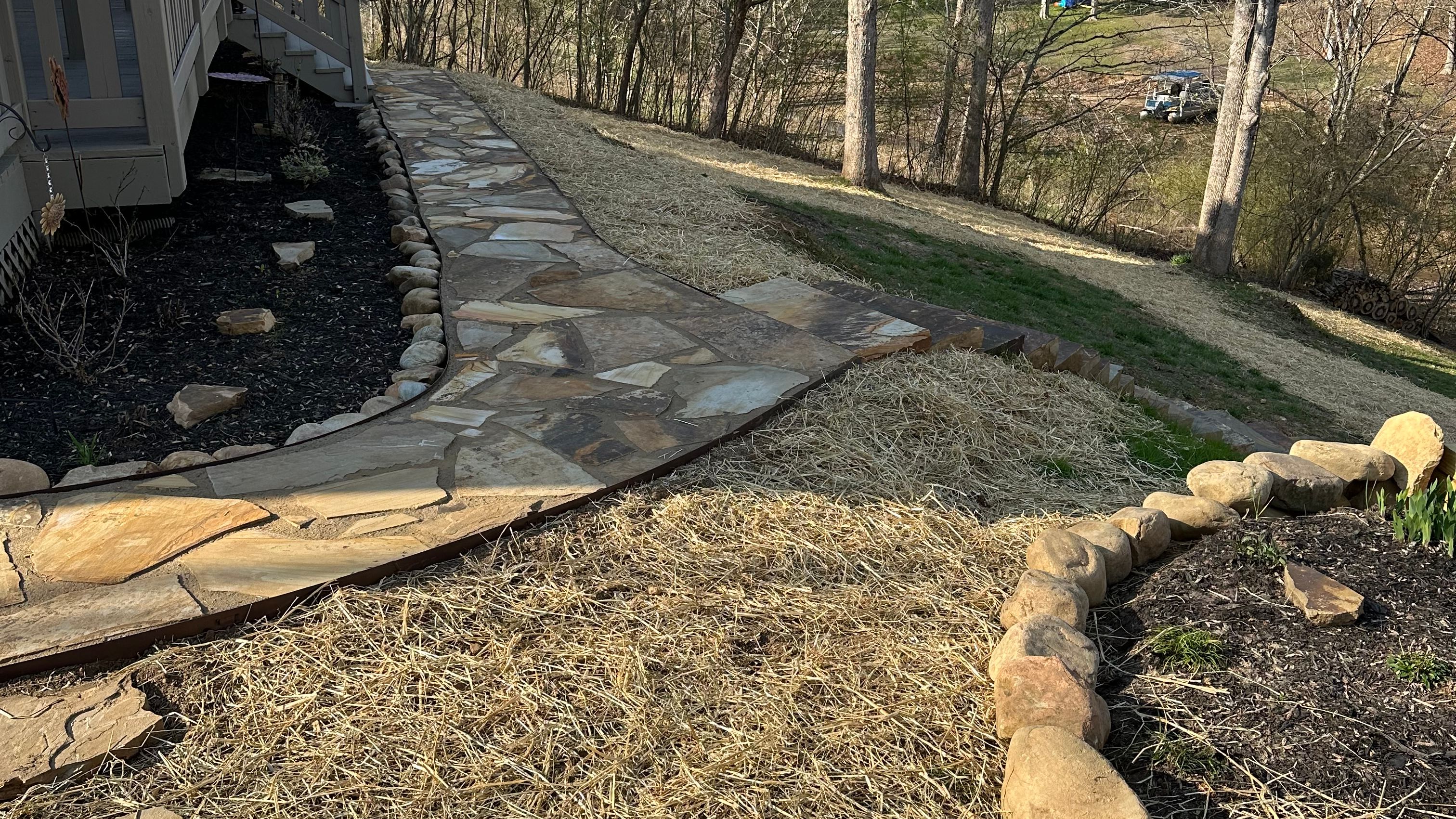
Water problems in a yard rarely start with the grass. Most of the time, they start with the slope.
Here in Kingston, we see a familiar pattern: heavy rain rolls off roofs and driveways, East Tennessee clay soil slows infiltration, and water takes the easiest path, which is often straight toward the house or into a low spot that never dries out. If you are dealing with persistent puddles, muddy ruts, or water collecting near your foundation, yard grading in Kingston TN may be the missing fix.
In this guide, we will show you the most common signs you need regrading, how to tell the difference between a grading issue and a drainage system issue, and what a proper drainage grading plan should include for properties in our region. We will also share what we look for during an on-site evaluation so you can make a confident decision before you invest in repairs.
Why grading matters so much in Kingston and Roane County
Grading is the “shape” of your yard. It controls where water goes after a storm, how quickly it moves, and whether it spreads out safely or concentrates in damaging ways.
In Kingston and across Roane County, grading problems tend to show up faster than homeowners expect for a few reasons:
- Clay-heavy soils are common. Clay soil grading is tricky because clay holds water, compacts easily, and drains slowly once it is saturated. Even a small low spot can stay soggy for days.
- Intense rainfall events. We often get sudden downpours that overwhelm shallow swales, clogged downspouts, and thin turf.
- New construction settlement. Backfill around foundations and utility trenches can settle for a few years, creating negative slope toward the home.
- Hard surfaces add runoff. Driveways, patios, and walkways shed water quickly. If the surrounding grade does not manage that flow, you get washouts and pooling.
Yard grading Kingston TN: the clearest signs you need regrading
Some drainage issues can be solved with targeted drains or downspout work. Others keep coming back because the yard is shaped incorrectly. Below are the most reliable signs we see on Kingston properties when regrading is the right next step.
1) Negative grading around the foundation
Negative grading around foundation means the soil slopes toward the house instead of away from it. When that happens, roof runoff and surface water collect at the base of your walls.
What you might notice:
- Water pooling along the foundation after rain
- Mulch floating or washing out of foundation beds
- Basement or crawl space dampness, musty odors, or efflorescence on masonry
- Soil erosion under stair landings, stoops, or porch edges
What we look for on-site:
- Low spots along the first 6 to 10 feet from the wall
- Settled backfill at corners and near downspouts
- Soil or mulch piled against siding (which can trap moisture and invite pests)
2) Standing water that lasts more than 24 to 48 hours
If you are trying to fix standing water in yard areas and the puddles linger well after the storm, you likely have a grade issue, a soil infiltration issue, or both.
- A low spot collecting runoff from multiple directions
- Compacted subgrade from construction equipment or repeated traffic
- Clay soil that is saturated and cannot absorb more water
When regrading is needed, we reshape the surface so water does not “park” in one area. When soil structure is a major contributor, we may also recommend soil conditioning steps or a drainage feature that works with clay, not against it.
Related reading if your issue is localized: How to Fix a Soggy Yard in Loudon Without Regrading Everything
3) Soggy low spots that kill grass or create mud
Soggy areas are not just annoying, they change how your yard functions.
Signs your low spot is more than a “wet week” problem:
- Grass thins out and weeds take over (sedges and rushes love wet soil)
- You get muddy footprints even when the rest of the yard feels firm
- Kids and pets track mud into the house for days after rain
- Mowers leave ruts or sink in the same zone every time
In East Tennessee, these spots are often formed by subtle grade changes, not dramatic dips. A half-inch drop across a small area can be enough to hold water when clay is saturated.
If heavy rain has already damaged your turf, this can help you prevent making it worse while you plan repairs: Lawn Care After Heavy Rain in Knoxville: Prevent Mud & Ruts
4) Washouts, gullies, or exposed roots after storms
Washouts happen when water is forced through a narrow path with enough speed to move soil. On sloped lots in Kingston, we often see:
- Channels forming along the edge of driveways
- Soil carving behind downspout outlets
- Mulch beds “blown out” and deposited downhill
- Tree roots exposed where topsoil has been stripped away
This is one of the most important signs you need regrading because it indicates an energy problem. Water is not just present, it is moving with force.
5) Water running toward the house from neighboring lots or the street
Sometimes the yard is not the only contributor. We frequently evaluate properties where:
- A neighbor’s downspout discharges toward the property line
- The street crown or ditch sends runoff into the driveway apron
- A swale that once carried water has been filled in over time
In these situations, regrading is still often the solution, but the plan must be careful about where water is redirected. The goal is to manage runoff responsibly and avoid creating a new issue for someone else.
6) New patios, walkways, or beds that changed drainage patterns
Hardscaping and landscaping improvements can unintentionally change drainage.
Examples we see:
- A new bed edge blocks sheet flow and traps water uphill
- A patio or walkway sheds runoff toward the lawn instead of a safe outlet
- Added topsoil around a feature creates a “dam” that holds water
If you are planning outdoor upgrades, it is smart to address grading first or at least coordinate it with the build. Our Hardscaping and Landscaping teams plan grades and drainage together so your finished space performs as well as it looks.
How we tell grading problems from drainage system problems
Homeowners often ask whether they need regrading or a French drain. The truth is that both can be correct, but for different reasons.
Here is how we think about it on Kingston properties:
When regrading is usually the best first step
Regrading is often the right move when:
- Water is ponding on the surface in multiple areas
- The yard slopes toward the house (negative grade)
- You see widespread sogginess, rutting, or erosion
- There is no clear surface path for water to leave the property
If the surface is shaped wrong, adding drains can become a constant maintenance issue because the drains are being asked to do the work the grade should be doing.
When a drainage system may be needed (with or without regrading)
- You have a defined collection point (like a downspout area) that needs piping
- There is a natural low area that cannot be raised due to property lines or hard surfaces
- You need to intercept water moving through soil (subsurface flow)
Often, the most durable fix is a combined approach: minor regrading to guide surface water into a collection area, then a properly designed outlet. If you want to compare common solutions, this is a helpful overview: French Drain vs. Dry Creek Bed for East TN Drainage
What a proper drainage grading plan includes for East Tennessee properties
Here is what we typically include when we design grading corrections in Kingston and nearby communities like Lenoir City and Knoxville.
Site evaluation and water source mapping
Before we move soil, we map how water is getting into the problem area:
- Roof runoff locations and downspout discharge points
- Driveway and sidewalk runoff direction
- Natural slope and any existing swales
- Low points and collection zones
- Signs of past flow, such as sediment deposits or erosion lines
We also look at how the yard behaves during real storms. If a homeowner can point out where puddles form first, or where water crosses the driveway, that information is extremely valuable.
Foundation protection grades (the non-negotiables)
For most homes, the grading near the foundation is the highest priority.
- A consistent slope away from the house in the immediate perimeter zone
- Bed shaping that prevents water from sitting against walls
- Downspout discharge that does not dump at the foundation
- Attention to corners, where settlement and pooling are common
Important note: we avoid piling soil or mulch against siding or weep holes. Proper separation protects materials and helps prevent moisture problems.
Clay soil grading strategies that actually work here
Clay changes the rules. Because it drains slowly, you need to focus on moving water across the surface to safe areas, not expecting it to soak in quickly.
Common strategies we use:
- Smoothing and reshaping to eliminate birdbaths and shallow depressions
- Swales that are wide and gentle, which move water without creating a trench
- Topsoil placement where appropriate to support turf recovery, while still maintaining stable compaction
- Stabilization with sod, seed, or erosion control methods so the new grade holds during the next heavy rain
If the yard is heavily compacted, we may recommend additional steps after grading, such as aeration or a soil improvement plan, depending on the season and the homeowner’s goals.
Safe discharge points and outlet planning
Every grading plan needs an exit strategy. Water must have a place to go.
We plan for:
- Discharge away from foundations and hardscape edges
- Avoiding concentrated flow onto neighboring property
- Keeping water off driveways and high-traffic paths when possible
- Long-term maintainability, including access for cleanouts if piping is used
If there is no good daylight outlet, we may discuss alternatives like dry creek beds, rain gardens, or other methods that slow and spread runoff in a controlled way.
Coordination with hardscape, landscaping, and maintenance
Grading is not a standalone project when you care about long-term results.
- Patio and walkway elevations so water sheds correctly
- Bed edges and curbing so they do not trap water uphill
- Retaining walls or terraces on sloped lots
- Mowing patterns and maintenance access
If you want one team to handle the full picture, our Property Maintenance program helps keep drainage paths clear, swales open, and turf healthy after improvements.
What regrading typically looks like (and what homeowners should expect)
Regrading does not always mean bringing in loads of dirt and rebuilding the whole yard. In many Kingston projects, the best solution is targeted and precise.
Common regrading scopes we do in East Tennessee
Depending on the site, regrading may involve:
- Rebuilding the slope along one side of the house where water collects
- Raising a low area with clean fill and topsoil, then reestablishing turf
- Creating a shallow swale to guide runoff around a patio to a safe outlet
- Correcting the transition between driveway and lawn where water concentrates
Timing and turf recovery
Regrading is easiest when the soil is workable and you can reestablish vegetation quickly.
- In warm seasons, sod can stabilize a new grade fast.
- In cooler windows, seeding can work well if you can protect it from washouts.
The key is not leaving bare soil exposed going into a rainy stretch. Stabilization is part of the job, not an afterthought.
Red flags to avoid when hiring a regrading contractor near me
If you are searching for a regrading contractor near me, look for someone who talks about water movement, not just “adding dirt.”
We recommend you be cautious if a contractor:
- Cannot explain where the water will discharge
- Plans to push soil against the house without discussing clearances
- Does not mention compaction, stabilization, or erosion control
- Suggests a single fix for every yard without evaluating soil and runoff sources
A real-world Kingston scenario we see often
One of the most common calls we get in Kingston is a homeowner who says, “We have a puddle by the back door and the lawn stays squishy.”
When we arrive, we often find a combination of:
- Downspouts dumping near the foundation
- Settled soil along the rear wall that created negative grade
- A slight bowl shape in the lawn where water collects
- Clay soil that stays saturated once it is wet
In that situation, a good fix is usually not a single drain dropped into the low spot. The better approach is:
- Correct the foundation-adjacent slope so water moves away from the home.
- Reshape the lawn so sheet flow is directed toward a safe side yard path.
- Stabilize the corrected grade with sod or seed and erosion control.
- If needed, add a defined drainage feature for overflow during heavy events.
That combination is what prevents the problem from returning next spring.
When regrading is not the right first move
We are big believers in doing the right fix, not the biggest fix. There are cases where regrading is not step one.
Examples:
- A single downspout is causing the issue and can be rerouted effectively.
- A clogged or broken underground line is backing up and surfacing.
- A retaining wall or hardscape feature is failing and changing the grade.
If you suspect a structural element is involved, we address that first and then finalize grading. The goal is to avoid redoing work.
Conclusion: stop guessing, start with the slope
If you are dealing with foundation pooling, soggy low spots, standing water, or washouts, those are strong signs you need regrading. In our area, yard grading in Kingston TN is often the most practical way to protect your home, restore usable lawn space, and prevent recurring mud and erosion.
If you want a professional set of eyes on your drainage issues in Kingston or anywhere in Roane County, we can help. Learn more about our Landscaping and Hardscaping services, and reach out when you are ready to map out a grading and drainage game plan that holds up to real East Tennessee rain.


