

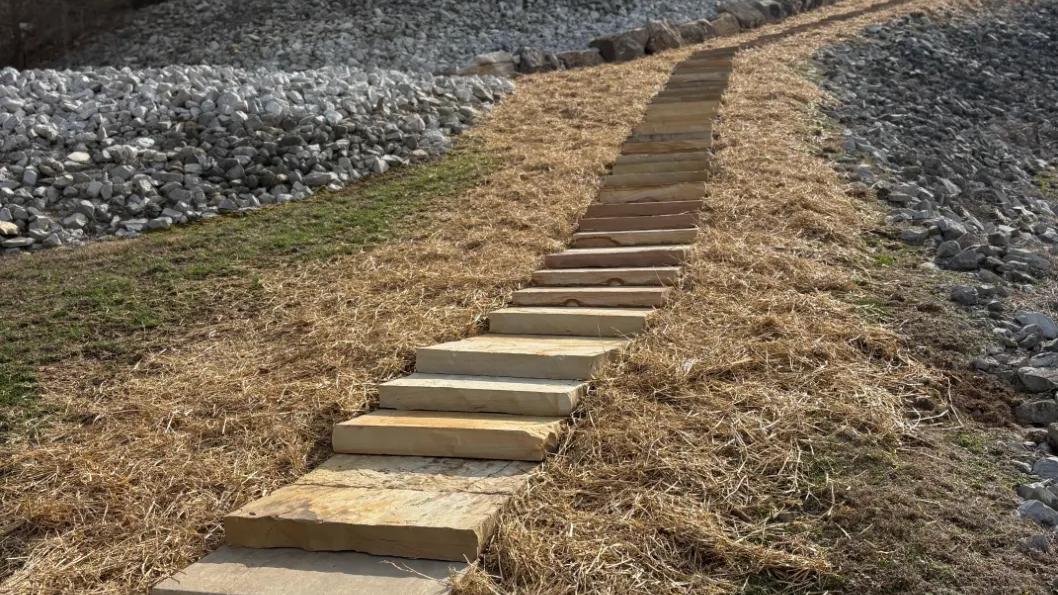
Sloped yards are part of life in East Tennessee. In neighborhoods around Knoxville, Oak Ridge, and Roane County, we regularly meet homeowners who love their view but dread the walk from the driveway to the patio, or from the back door down to the fire pit. When a slope is steep enough, a simple path turns into a safety issue, especially in our wet seasons when clay soil stays slick.
If you are researching outdoor steps on slope Tennessee properties, the material choice matters as much as the layout. Stone, segmental block, and timber can all work, but they behave differently in our freeze-thaw cycles, heavy rain events, and common red clay conditions. The right solution is the one that stays level, drains properly, and feels secure underfoot year-round.
In this guide, we break down stone steps vs block steps vs timber for landscape stairs East Tennessee homes. We will cover what we look for on-site, how drainage behind steps prevents shifting, what frost heave can do to poorly built stairs, and the tread and riser guidelines we use to keep steps comfortable and safe. We will also talk about step lighting, because most falls happen when you cannot clearly see the edge.
Start with the slope: what we evaluate on East Tennessee sites
Before we recommend any material, we look at the conditions that make stairs succeed or fail on a hillside. This is the part many DIY plans skip, and it is why some steps look great for one season and then start leaning.
1) Grade, run, and where the water wants to go
On a sloped yard, stairs are basically a controlled interruption in the grade. Water will still try to move downhill, and if it gets trapped behind a riser, it will push, saturate, and eventually shift the structure.
On properties in Knoxville and Oak Ridge, we often see runoff coming from:
- Downspouts that discharge onto the slope
- Driveway or patio edges that shed water toward the yard
- Natural swales that concentrate flow during storms
We look for a clean plan to move water around or through the stair system. If you want a deeper dive on what proper drainage looks like behind hardscape structures, our article on Retaining Wall Drainage: Gravel, Pipe and Weep Holes Explained applies to stairs as well, because the physics are the same.
2) Soil type and compaction (clay changes everything)
Much of our service area has clay-heavy soil. Clay holds water, expands when wet, and shrinks when dry. That movement is a big reason steps settle unevenly if they are built on poorly compacted subgrade.
For long-term performance, we focus on:
- Removing organic soil under the stair footprint
- Building a compacted aggregate base (not just “a little gravel”)
- Using geotextile fabric where it helps separate clay from base stone
3) Freeze-thaw and frost heave in East Tennessee
We do not have the deep frost depths of northern states, but we do get repeated freeze-thaw cycles. When water sits in soil or in voids behind a riser and freezes, it can lift and shift stair components. Then when it thaws, it rarely settles back perfectly.
The takeaway is simple: drainage behind steps and a well-compacted base do more to prevent movement than the material alone.
Stone steps: premium look, excellent longevity, higher install demands
Natural stone steps are often the top choice for homeowners who want a “built for the property” look. In East Tennessee, stone can feel right at home against wooded lots, lake-area landscapes, and traditional brick homes.
Best uses for stone steps on sloped yards
Stone is a great fit when:
- You want a high-end, timeless finish
- You need wide, stable treads for heavy foot traffic
- You have room for larger landings and gentle transitions
- You are matching other natural elements like boulders or creek rock
Pros of stone landscape stairs in East Tennessee
- Longevity: Properly installed stone can last decades.
- Weight and stability: Heavier pieces resist minor soil movement better than lightweight options.
- Natural traction options: Thermal-finished, flamed, or cleft surfaces can improve grip.
- Great curb appeal: Stone tends to increase perceived value.
Cons and common pitfalls we see
- Base prep is not optional: Stone will not “float” on a thin base. If the base settles, the stone settles.
- Irregular thickness requires skill: Many stone steps are not perfectly uniform. The installer has to manage consistent riser heights.
- Cost: Material and labor are typically higher than block.
Drainage details that matter with stone
For stone stair systems, we typically incorporate:
- A compacted crusher-run or similar base layer
- A leveling layer suited to the stone type
- Gravel zones behind risers where needed
- Positive drainage paths so water does not pond behind the stair line
If your slope also needs structural support, combining steps with a small retaining wall is common. That is where our Hardscaping team can design the stairs and the supporting grades as one system.
Segmental block steps: consistent, repairable, and often the best value
When homeowners ask us to compare stone steps vs block steps, block often wins on consistency and predictability. Segmental retaining wall block and matching step units are engineered products, which means they are manufactured to consistent sizes and designed to lock together.
Best uses for block steps
Block steps are a smart option when:
- You want clean lines and a finished look
- You need a durable solution with controlled dimensions
- You want a system that is easier to repair if a section ever shifts
- You are already planning a block retaining wall or terrace
Pros of block steps for yard slope solutions
- Uniform riser heights: Consistency improves safety and comfort.
- System engineering: Many products have caps, treads, and corner options that make details cleaner.
- Good traction: Many blocks have textured faces and caps with grip.
- Repairability: If a tread settles due to an unexpected drainage issue, it can often be re-leveled without replacing the whole staircase.
Cons and tradeoffs
- Not as “organic” looking as natural stone: Some homeowners prefer a natural aesthetic.
- Quality varies: Lower-grade block can fade or show wear sooner.
- Still needs real base work: Block is forgiving, but not magic. Poor compaction still leads to movement.
Drainage behind block steps
Block stairs are often built like a small retaining structure, especially on steeper slopes. We plan for:
- Free-draining gravel behind any riser wall sections
- Perforated drain pipe where water volume is high
- Outlets that daylight safely away from the stairs
If you are dealing with constant runoff or soggy areas near the stair location, it may make sense to address drainage first. Our post on French Drain vs. Dry Creek Bed for East TN Drainage can help you understand which approach fits your yard.
Timber steps: budget-friendly upfront, higher maintenance long-term
Timber steps are common on wooded lots and “backyard trail” style access routes. They can work as a practical solution, but in East Tennessee’s humidity and rainfall, they require realistic expectations.
When timber steps make sense
We typically recommend timber steps when:
- The stairs are in a secondary area (garden access, trail to a creek, etc.)
- You want a faster install and lower upfront cost
- You are okay with periodic replacement or refurbishment
- The design can include strong drainage and anchoring
Pros of timber steps
- Lower initial cost: Materials are usually less expensive.
- Natural look: Especially in wooded settings.
- Quick to build: Good for simpler access needs.
Cons we see in East Tennessee
- Rot and insect risk: Even treated lumber breaks down over time in moist soil contact.
- Movement on slopes: Timbers can shift if they are not pinned, anchored, and backfilled correctly.
- Surface slickness: Algae and mildew can make shaded steps slippery.
If you choose timber, do these things
To make timber steps safer and longer-lasting, we look for:
- Gravel base and gravel backfill, not soil packed tight behind timbers
- Proper anchoring (rebar pins, deadmen, or structural stakes depending on design)
- A drainage path so water does not sit behind each riser
- A tread surface plan, such as compacted gravel infill, textured tread boards, or traction strips
For many homeowners, timber becomes a “phase one” solution. Later, when they invest in a patio or outdoor living area, they upgrade to stone or block for a permanent finish.
Hardscape steps design: tread and riser guidelines for comfort and safety
Even the best materials fail the user if the steps feel awkward. In our experience, the biggest comfort issue is inconsistent riser height. The biggest safety issue is poor visibility of the step edge.
Practical tread and riser guidelines we use
While exact requirements can vary by application and local code interpretation, these are the comfort ranges we commonly design within for residential outdoor stairs:
- Riser height: Aim for about 6 to 7.5 inches, and keep every riser consistent.
- Tread depth: Aim for about 12 to 16 inches for outdoor comfort, especially where people carry groceries, coolers, or yard tools.
- Consistency matters most: A single riser that is off by even half an inch can trip people because your stride expects repetition.
Landings and width
On sloped East Tennessee lots, we often add landings for both safety and drainage control.
- Width: We often recommend at least 4 feet wide for primary access routes, wider if two people will pass or if you want a more welcoming look.
- Landings: Consider a landing every 8 to 12 steps on longer runs, or where the path changes direction.
Landings also give us a chance to intercept runoff and redirect it before it gains speed.
Edge definition and slip resistance
Outdoor stairs need clear edges. We like:
- Contrasting cap color or stone nosing
- Slight texture on the tread surface
- Avoiding polished stone in shaded, damp areas
If your steps are under trees or on the north side of the home, plan for seasonal algae. Routine cleaning becomes part of the maintenance plan.
Drainage behind steps: the detail that prevents shifting and heave
If we could pick one topic that saves homeowners money on yard slope solutions, it is drainage. Most stair failures we are called to fix trace back to trapped water.
What “good drainage” looks like in practice
Depending on the stair type, we typically design for:
- A free-draining base: Compacted aggregate that does not hold water like soil.
- Gravel backfill behind risers: Especially for block or stone riser walls.
- A path for water to exit: Daylight outlets, tie-ins to existing drainage routes, or surface swales.
- Surface grading: The surrounding grade should shed water away from the stairs, not toward them.
Common local problem: downspouts dumping onto the stair line
In Kingston and throughout Roane County, we often see downspouts that discharge right onto a slope. That water cuts channels, saturates the stair base, and creates mud that gets tracked onto treads.
Sometimes the fix is as simple as rerouting downspouts and adding a small swale. Other times, it calls for a French drain or dry creek bed to manage heavy flow.
Frost heave prevention
Frost heave risk goes way down when:
- Water is not trapped behind risers
- Base stone is compacted in lifts
- Fine soils are separated from open aggregate where appropriate
Material choice helps, but water management is what keeps the structure stable through winter.
Lighting and visibility: make steps safer after dark
Step lighting options we recommend
For residential outdoor stairs, we commonly design lighting around three goals: illuminate the tread, define the edge, and avoid glare.
- Low-voltage step lights: Mounted on risers or adjacent walls to wash light across the tread.
- Path lights: Placed to guide approach and landings.
- Downlighting from trees or eaves: Great for a natural look when the site allows.
If you want ideas tailored to our region, our post on Outdoor Lighting Ideas for Safer, Better Yards in Oak Ridge is a strong companion read.
Placement tips that improve safety
- Light the top landing and bottom landing clearly.
- Avoid placing fixtures where they shine directly into your eyes on the way up.
- Highlight changes in direction, such as switchbacks.
When we build stairs as part of a larger outdoor living plan, we coordinate lighting early so wiring and conduit are protected and hidden.
Choosing the right material: a practical comparison for East Tennessee homeowners
Here is how we typically summarize the decision when a homeowner in Lenoir City or Loudon asks what to choose.
Choose stone steps if you want
- The most natural, high-end appearance
- Long service life with minimal structural maintenance
- A design that blends with boulders, stone walls, or natural landscapes
Choose block steps if you want
- Consistent dimensions and a very predictable finished feel
- A strong match for retaining walls and terraced yards
- A durable, repairable system with excellent value
Choose timber steps if you want
- A lower upfront cost for secondary access
- A rustic look in wooded areas
- A solution you are willing to maintain and eventually replace
No matter which material you choose, the winning formula in landscape stairs East Tennessee is the same: solid base prep, planned drainage, consistent risers, and good visibility.
A real-world scenario we see often in hilly neighborhoods
When we rebuild it, we typically:
- Rework the route to reduce the steepness, often with a gentle switchback.
- Add a landing where people naturally pause, such as near a grill area or gate.
- Build proper base and drainage so water does not sit behind the risers.
- Install steps with consistent riser heights and comfortable tread depth.
- Add low-voltage lighting so the stair edges are visible year-round.
The result is not just better access. It changes how the family uses the yard, because the route feels safe enough for kids, guests, and anyone carrying food to the patio.
If you are planning a broader outdoor upgrade, our Landscaping team can help tie stairs into planting beds, grading, and erosion control, so the finished project looks intentional, not patched together.
Conclusion: build stairs that stay put, drain well, and feel safe
Outdoor steps on a slope are one of the most important safety features on a hilly East Tennessee property. Stone, block, and timber can all be good choices, but they perform very differently depending on drainage, base preparation, and how the stairs are used.
If you want the most timeless finish, stone is hard to beat. If you want consistent dimensions and excellent long-term value, block is often the best all-around solution. If budget is the priority and the stairs are in a secondary area, timber can work with the right drainage and maintenance plan.
When you are ready to plan hardscape steps design that fits your yard and our local conditions in Kingston and surrounding communities, we can help. Reach out through our Hardscaping service to talk through layout options, drainage behind steps, and lighting that makes every trip up and down safer.


