

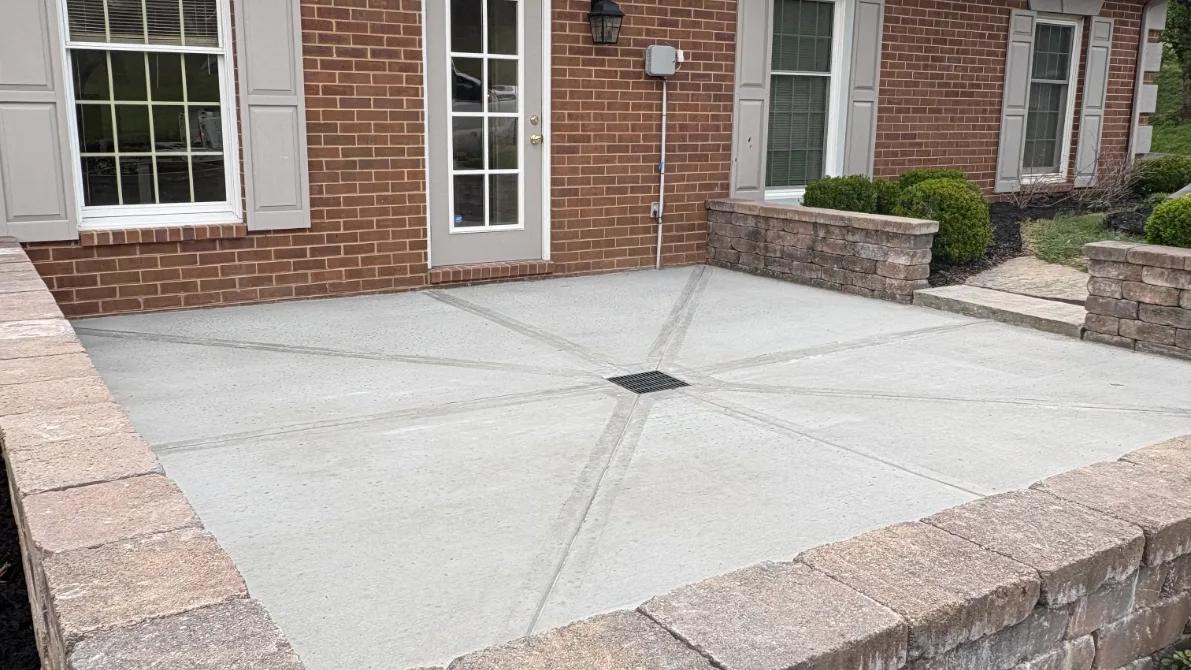
Choosing a patio or walkway material in Loudon is not just about looks. In East Tennessee, we deal with heavy rain, clay soil, and enough freeze-thaw swings to expose weak bases, poor drainage, and shortcuts in installation. That is why homeowners ask us the same question every season: stamped concrete or pavers, which holds up better long-term?
In this guide, we will compare stamped concrete vs pavers in Loudon the way it plays out in real yards, not in a brochure. We will break down typical patio cost in Loudon TN, what repairs actually look like when something goes wrong (cracking vs shifting), how each surface handles drainage and runoff, and what you can expect for lifespan and maintenance. By the end, you should be able to choose the best patio material for your priorities, then request quotes with confidence.
Quick comparison: stamped concrete vs pavers for Loudon patios and walkways
Here is the high-level difference we see in the field.
- Stamped concrete is a single slab with a decorative pattern and color. It can look great, but it is more sensitive to subgrade movement and freeze-thaw cracking.
- Concrete pavers are individual units over a compacted stone base. They can shift if the base is not built correctly, but they are typically easier to repair because you can lift and reset sections.
If you are planning a new outdoor living space, our Hardscaping team in the Kingston area builds both systems, and the right answer depends on drainage, grade, access, and how you use the space.
Cost in Loudon: what you are really paying for
When homeowners search “pavers vs stamped concrete patio,” cost is usually the first filter. The tricky part is that the price difference is not only about the surface. It is about what is underneath.
Typical installed cost ranges (what affects the number)
We do not quote pricing online because every property is different, but we can share the cost drivers we see in Loudon and across East Tennessee:
Stamped concrete cost drivers
- Excavation and base prep (often thinner than a paver base, which can be a problem if the soil is weak)
- Reinforcement (rebar or wire mesh), control joints, and slab thickness
- Coloring method (integral color, release powder, stains)
- Sealer system and number of coats
- Complex shapes, steps, and tight access
Paver patio cost drivers
- Depth of excavation and base thickness (this is where quality lives)
- Type of base stone and bedding layer
- Edge restraint system (critical to prevent spreading)
- Paver style, thickness, and pattern complexity
- Polymeric sand vs traditional joint sand
- Drainage details (swales, drains, tie-ins)
In many Loudon projects, pavers come in higher upfront because the base is deeper and more labor-intensive. Stamped concrete can be less expensive initially, especially for large, simple rectangles with good access.
The cost question we ask homeowners first
When we walk a property in Loudon, we usually start with one question: Where does water go during a heavy rain?
If runoff crosses the patio area, if downspouts dump nearby, or if the yard stays soft, the cheapest install often becomes the most expensive fix later. Paying for drainage and base prep up front is usually the best long-term value, regardless of material.
If drainage is already a known concern, our article on Catch Basin vs Trench Drain: Outdoor Drainage 101 for East Tennessee can help you understand the options before you compare bids.
Freeze-thaw durability in Tennessee: cracking vs shifting
This is where the difference between a continuous slab and a segmented surface matters.
Stamped concrete in freeze-thaw cycles
Stamped concrete is still concrete. The stamped pattern and color do not change the physics.
What we see most often:
- Hairline cracking that starts at corners, re-entrant angles, or areas where the slab is thinner.
- Cracks that widen over time if water gets into the crack, freezes, and expands.
- Surface scaling or flaking in spots if the mix, finish timing, or de-icing products are not compatible.
Control joints help manage where cracks occur, but they do not eliminate cracking. In our experience, stamped concrete looks best long-term when:
- The subgrade is well-compacted and not saturated
- The slab thickness and reinforcement match the use (patio vs driveway approach)
- Drainage keeps water from sitting on or under the slab
- The sealer is maintained so water does not soak in as easily
Pavers in freeze-thaw cycles
Pavers flex as a system. That is an advantage when the ground moves.
What we see most often:
- Minor settling or heaving in localized areas, usually tied to base thickness, compaction, or water management.
- Joint sand loss after heavy rain if polymeric sand is not installed correctly or if runoff concentrates.
If you want to understand what “proper base” really means, we recommend reading Paver Patio Base in East TN: Depth, Stone and Compaction Tips. It is one of the biggest separators between a patio that lasts and one that becomes a maintenance project.
Repair reality: paver repair vs concrete repair
This is the section that usually changes minds, especially for homeowners who plan to stay in their home for a long time.
Concrete repair: what it looks like when stamped concrete fails
Stamped concrete repairs are possible, but they are rarely invisible.
Common repair scenarios:
- Crack repair: You can fill cracks, but color matching and texture matching are difficult. Even when done well, repairs often remain noticeable.
- Section replacement: If a slab panel needs removal, you typically cut out a section at joints. The new concrete will cure differently and can vary in color, especially with stamped patterns.
- Drainage correction: If the slab is holding water due to settlement or poor slope, the fix can be invasive. In many cases, correcting slope means replacement.
Stamped concrete can still be a good choice, but you should go in knowing that repairability is not its strong suit.
Paver repair: why it is usually more forgiving
With pavers, the surface is modular. That makes paver repair vs concrete repair a different conversation.
Common repair scenarios:
- Low spot or birdbath: We can lift pavers, adjust bedding sand, re-compact base if needed, and reset.
- Utility access: If you ever need to access a line under the patio, pavers can often be removed and reinstalled.
- Stains or damage: Individual pavers can be replaced without touching the rest of the patio.
The key is having extra matching pavers available. We often recommend homeowners keep a small attic stash from the original install for future spot replacements.
Drainage performance in Loudon: why slope and runoff matter more than material
In our part of Tennessee, drainage is not an “add-on.” It is part of the design.
Loudon neighborhoods can include everything from lake-influenced humidity near Tellico areas to tighter clay soils that hold water after storms. Even a perfectly installed patio can fail early if runoff is directed toward it.
How stamped concrete handles water
Stamped concrete is essentially impermeable. Water must run off the surface.
That means:
- The patio needs positive slope away from the house.
- Downspouts should not discharge onto the slab.
- Adjacent landscaping and grade must keep soil from washing onto the patio.
If you are seeing soggy areas near where a patio would go, you may also want to read How to Fix a Soggy Yard in Loudon Without Regrading Everything to understand targeted drainage solutions.
How pavers handle water (standard and permeable)
Standard pavers are not “permeable” by default, but the joints and base can allow water to move through.
Two common approaches:
- Traditional pavers with polymeric sand: Water still sheds off the surface, but the system can be more forgiving if small amounts of moisture get into the base.
- Permeable pavers: Designed to drain through wider joints and an open-graded base. This can reduce runoff and puddling, but it must be designed correctly.
If you are interested in a drainage-forward option, our guide on Permeable Pavers in Knoxville: Pros, Cons, Costs applies to Loudon conditions as well, especially where clay soil and heavy rains are part of the equation.
Maintenance and appearance over time (what homeowners do not see on day one)
Both stamped concrete and pavers can look fantastic right after installation. The difference is what they look like after three summers, a few winters, and a couple of big rain events.
Hardscape maintenance in Tennessee for stamped concrete
Stamped concrete maintenance is mostly about protecting the surface and keeping it clean.
What we typically recommend:
- Reseal on a schedule based on sun exposure and wear. High-traffic areas and full sun often need more frequent attention.
- Use gentle cleaners and avoid harsh pressure washing that can strip sealer.
- Be cautious with de-icers in winter. Some products can contribute to surface damage.
Hardscape maintenance in Tennessee for pavers
Paver maintenance is usually more mechanical than chemical.
What we typically recommend:
- Re-sand joints when needed, especially after heavy rains or aggressive cleaning.
- Spot treat weeds if they appear in joints. Most “weeds in pavers” come from windblown seeds, not from below.
- Consider sealing only if you want stain resistance or color enhancement, and do it with the right product for our humidity.
If you are on the fence about sealing, we break down the pros and cons in Paver Sealing in East Tennessee: Do You Need It (Really)?.
Lifespan and long-term value: what lasts longer in East TN
Homeowners often ask for a simple answer on lifespan. The honest answer is that both materials can last decades, but the failure modes are different.
Expected lifespan (realistic ranges)
In East Tennessee conditions, with good installation and normal residential use:
- Stamped concrete: Often performs well for many years, but cracking risk is always present. The decorative finish can require periodic resealing to maintain appearance.
- Pavers: Often have a long service life because individual units can be replaced and the system can be re-leveled. The base and edge restraint determine whether it stays tight.
If we are talking strictly about long-term value, we usually give pavers the edge because:
- Repairs are typically localized
- Future changes (adding a step, adjusting a border, tying into a walkway) are easier
- The surface can be refreshed without full replacement
Stamped concrete can still be a strong value when:
- The site is stable and well-drained
- The design is simple (fewer corners and cutouts)
- The homeowner is comfortable with periodic resealing
Which is the best patio material for your Loudon home?
We think of this as a match between your property conditions, your tolerance for maintenance, and your expectations for repair.
Choose stamped concrete when
Stamped concrete can be a great fit if:
- You want a seamless look and a specific stamped pattern
- Your patio area has stable soil and good drainage
- You prefer a lower upfront cost and are comfortable with resealing
- You are okay with the possibility of visible repairs if cracking occurs
Choose pavers when
Pavers are often the better fit if:
- You want the most forgiving option for freeze-thaw patio Tennessee conditions
- You value repairability and the ability to re-level sections
- Your site has clay soil, runoff, or a history of settling
- You want design flexibility (borders, inlays, future expansions)
Our field rule of thumb for Loudon
If water management is even slightly questionable, we lean toward a paver system with a properly built base and a clear drainage plan. In our experience, drainage is the deciding factor more often than style.
If you are still exploring options, our Hardscaping team can walk your property and explain what we would build and why, based on grade, soil conditions, and how you plan to use the space.
What to ask when comparing quotes (to protect your investment)
In the consideration stage, the best thing you can do is compare scope, not just price. Here are practical items we encourage homeowners to ask about.
For stamped concrete bids
- What slab thickness is included, and is reinforcement specified?
- Where will control joints be placed?
- How will the contractor handle drainage and slope away from the house?
- What sealer is used, and what maintenance schedule is recommended?
- How are edges and transitions handled to reduce cracking risk?
For paver bids
- How deep is excavation, and what is the base thickness?
- What type of base stone is used, and how is it compacted?
- Is geotextile fabric used where soil is soft or clay-heavy?
- What edge restraint is installed, and how is it anchored?
- What jointing sand is used, and is polymeric sand included?
If you notice that one bid is missing detail on base depth or drainage, that is usually where corners are being cut.
Conclusion: choosing between stamped concrete and pavers in Loudon
When homeowners compare stamped concrete vs pavers in Loudon, the right choice usually comes down to how your yard handles water and how you want repairs to work if something shifts or cracks. Stamped concrete can deliver a beautiful, continuous look with a potentially lower upfront price, but cracking and visible repairs are the tradeoff. Pavers often cost more initially, but they tend to win on repairability, flexibility, and long-term serviceability in East Tennessee freeze-thaw and heavy rain conditions.
If you are ready to move from research to a real plan, we would be glad to help. Start with our Hardscaping service page, or if you are in the area, explore how we serve homeowners in Loudon. We will evaluate grade, drainage, and soil conditions, then recommend a patio or walkway system built to last in Tennessee weather.
Disclaimer: Cost and lifespan vary by site conditions, design complexity, and installation quality. We recommend an on-site evaluation for accurate pricing and material recommendations.


