

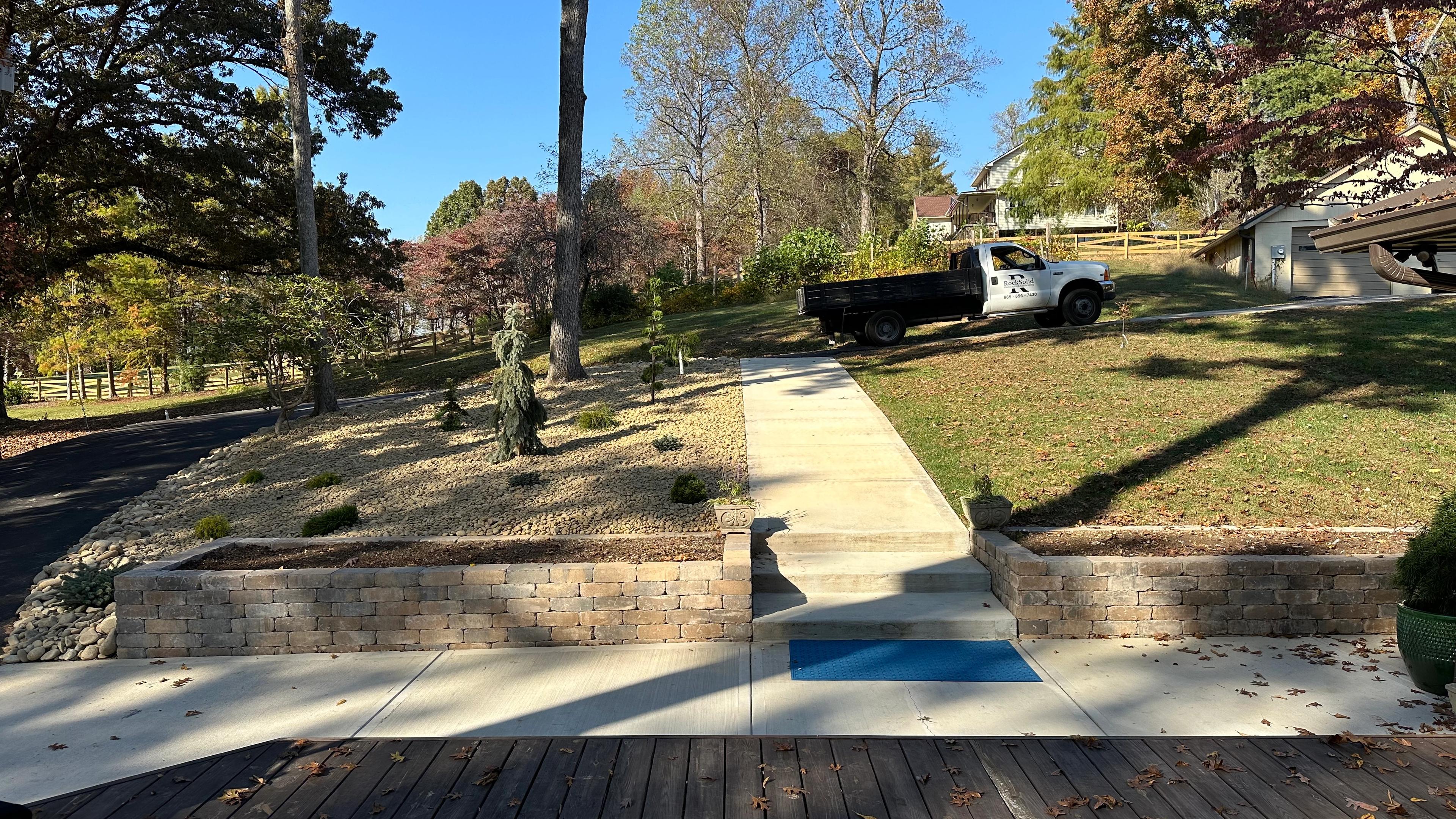
Busy schedule, clay soil, summer heat, and those sudden East Tennessee downpours can make a front yard feel like a second job. We hear it all the time in and around Kingston, "We want curb appeal, but we do not want to spend every weekend weeding and watering." The good news is that low maintenance landscaping in Roane County is absolutely doable when the design does the heavy lifting.
In this guide, we will walk you through a practical, climate-smart approach to front yard landscaping in East Tennessee. You will learn how we plan simple bed layouts that reduce turf and trimming, which groundcovers actually behave in Tennessee yards, how to choose drought-tolerant plants Tennessee homeowners can rely on, and which landscape edging ideas keep mulch and rock where they belong. We will also cover mulch and stone strategies that look clean and stay that way, plus a realistic seasonal routine that keeps the whole yard on autopilot.
If you want a front yard that looks intentional from the street, holds up to our weather, and does not demand constant upkeep, start here.
Start with a low maintenance landscape design that shrinks the work
Use bed shapes that are easy to mow around
When we design front beds, we aim for smooth, sweeping curves or clean straight lines that you can follow with a mower in one pass. Tight scallops and tiny islands look cute on paper, but they create trimming work and invite string trimmer damage on shrubs.
- Minimum bed depth: 6 to 8 feet where possible
- Layering: taller shrubs or small trees in back, mid-size shrubs in the middle, groundcovers at the edge
- Fewer plant varieties: repeat the same 3 to 6 plants for a cohesive look and simpler care
This approach also helps with curb appeal low upkeep goals because repetition reads as "designed" even when the plant list is short.
Reduce turf where it struggles anyway
In East Tennessee, we often see front lawns that are too shaded, too compacted, or too steep to be enjoyable. Those areas become patchy, muddy, and high maintenance.
Instead of fighting them, we convert problem turf into:
- Mulched planting beds
- Groundcover zones
- Decorative stone areas with grouped plantings
- Hardscape features like walkways or small sitting pads
If you are curious about how hardscape choices affect weeds and upkeep, our comparison post is helpful: Gravel vs Pavers for East TN Walkways: Pros, Cons, Costs.
Plan for drainage up front
Roane County soils often have a high clay content, which means water can sit after heavy rain. If we ignore drainage, mulch floats, plants rot, and the yard becomes messy fast.
We look for:
- Downspout discharge points
- Low spots near sidewalks and driveways
- Slopes that send water toward the foundation
- Compacted soil near construction zones
Sometimes the low maintenance move is adding a subtle swale, a dry creek bed with river rock, or adjusting grades before planting. That is not glamorous, but it is what keeps the yard looking good for years.
For homeowners who want to see how we evaluate a property and build a plan around these realities, read: Landscape Design Process in Roane County: What to Expect.
Pick groundcover for Tennessee yards that blocks weeds and handles heat
Groundcovers are one of the best tools for low maintenance front yard landscaping because they reduce bare soil. Bare soil is an open invitation for weeds, erosion, and mulch washouts.
That said, not every groundcover behaves well in our climate. We focus on plants that can handle humid summers, occasional winter cold snaps, and the sun and shade patterns typical of Roane County neighborhoods.
Groundcovers we use often in Roane County front yards
Your exact pick depends on sunlight, foot traffic, and whether deer pressure is high in your area.
- Creeping juniper (Juniperus horizontalis): Great for sunny slopes, evergreen, very low watering once established.
- Creeping thyme (Thymus serpyllum): Sunny edges and between stepping stones, light traffic, fragrant, prefers well-drained soil.
- Liriope (Liriope muscari): Part shade to shade, tough, clean border look, good massing plant.
- Pachysandra: Shade groundcover, good under trees, needs decent soil prep and consistent moisture during establishment.
- Sedum varieties: Sunny, drought tolerant, good for rockier beds and hot spots near driveways.
We are careful with aggressive spreaders. Some plants can become a long-term maintenance problem if they escape beds or crowd out other plantings.
Installation details that make groundcovers truly low upkeep
Groundcover success is mostly about the boring parts:
- Kill existing weeds and turf thoroughly before planting.
- Loosen and amend soil in clay-heavy spots so roots can expand.
- Plant densely enough to close gaps. Wide spacing saves money today and costs you weeding time for the next two years.
- Mulch lightly at first (about 1 inch) so the soil stays cool and moist.
- Water consistently for 6 to 10 weeks after planting, then taper.
Once groundcovers knit together, you get a living weed barrier that looks finished from the street.
Choose drought-tolerant plants Tennessee homeowners can count on
Drought-tolerant does not mean "never water," especially in year one. It means the plant can handle typical East Tennessee summer dry spells after it is established.
When we build front yard landscaping in East Tennessee, we aim for plants that look good with minimal pruning, do not flop after heavy rain, and are not prone to constant disease issues in humidity.
Reliable low-water shrubs and perennials for East Tennessee
Here are a few categories we reach for often, depending on sun exposure and the look you want.
Sun to part sun
- Panicle hydrangea (Hydrangea paniculata): More sun-tolerant than bigleaf hydrangea, great structure, prune once a year if desired.
- Spirea: Durable, easy, blooms well, simple shaping.
- Daylilies: Tough, forgiving, good mass plant.
- Coneflower (Echinacea): Pollinator-friendly, handles heat.
- Russian sage (Salvia yangii): Airy texture, drought tolerant, cut back once per year.
Part shade to shade
- Hellebores: Evergreen-ish foliage, early blooms, low fuss.
- Ferns: Great for woodland edges, minimal care.
- Hostas: Classic shade plant, watch for deer in some neighborhoods.
Evergreen structure (the backbone of low upkeep curb appeal)
- Boxwood varieties (site-dependent): Clean look, light pruning.
- Hollies: Many are tough and adaptable.
- Dwarf conifers: Great for year-round form and minimal pruning.
We also like using native and adaptive plants whenever they fit the site because they tend to be resilient in local conditions. If you want a deeper plant list that is tuned to our region, see: Native Plants for East TN: Low-Maintenance Landscape Picks.
A simple plant palette that looks designed
One of our favorite "busy homeowner" formulas is a three-layer bed with repetition:
- Back layer: 3 to 5 evergreens (for year-round shape)
- Middle layer: 5 to 9 flowering shrubs or perennials (seasonal color)
- Front edge: one groundcover used in mass (weed control and clean lines)
When you repeat plants in groups of 3, 5, or 7, the bed reads as intentional. It also makes maintenance easier because everything in that zone tends to want similar water and sun.
What we avoid when the goal is low maintenance
Some plants are beautiful but tend to create more work in our climate.
- High-shear hedges that require frequent trimming
- Plants that constantly drop messy fruit or pods near walkways
- Species that are prone to fungal issues in humid summers
- Overly tender plants that need winter protection every year
We are always happy to talk through options during a site visit because what is low maintenance for one yard can be high maintenance for another depending on sun, soil, and deer.
Landscape edging ideas that actually reduce trimming and bed washout
Edging is one of the most overlooked elements of curb appeal low upkeep projects. Without a real edge, grass creeps into beds, mulch migrates, and you end up re-cutting bed lines multiple times per season.
Pick an edging style that matches your maintenance goals
Here are practical landscape edging ideas we use in Roane County, along with how they perform.
- Steel edging: Clean, modern look, holds curves well, excellent separation between turf and beds.
- Aluminum edging: Similar benefits to steel, often used for lighter-duty applications.
- Concrete or stone curb edging: Very durable, great for keeping mulch in place on slopes.
- Natural cut edge (spade edge): Looks great when maintained, but it requires re-cutting more often.
If you want the lowest trimming workload, a defined hard edge (steel, curb, or stone) usually wins.
Edging details that matter in East Tennessee
We install edging with a few local realities in mind:
- Depth and anchoring so it does not heave or shift
- Water flow paths so edging does not act like a dam in a downpour
- Mower-friendly height so you are not scalping turf along the edge
In yards with runoff issues, we may combine edging with a small gravel strip or a rock channel to keep mulch from washing onto sidewalks and driveways.
If you are considering upgrading walkways, borders, or other hardscape features as part of the front yard plan, our Hardscaping team can help you choose materials that look sharp and stay low upkeep.
Mulch vs stone in Roane County: how to choose and how to install it right
Mulch and stone are not just aesthetic choices. They change how often you weed, how your plants handle heat, and how the bed looks after a storm.
When mulch is the best low maintenance choice
Mulch is often the most forgiving option for planted beds.
Benefits:
- Improves soil as it breaks down
- Helps regulate moisture and temperature
- Easier to refresh than reworking stone
Our best-practice mulch specs for most Roane County front beds:
- Depth: 2 to 3 inches (more than 3 inches can cause root and moisture issues)
- Keep mulch off trunks and stems: leave a small gap to prevent rot
- Refresh timing: usually once per year, sometimes every 18 months depending on sun and slope
Mulch is also easier to adjust when you add plants later.
When decorative stone makes sense
Stone can be very low maintenance in the right application, especially in hot, sunny areas where mulch tends to float or break down quickly.
Stone works well for:
- Dry creek beds and drainage features
- Foundation zones with minimal planting
- Areas that get blasted by sun and reflected heat
- Side yard utility paths
Key installation steps that keep stone from becoming a weed farm:
- Proper base prep (remove organics and level the area)
- Commercial-grade landscape fabric only where appropriate
- A thick enough stone layer (typically 2 to 4 inches depending on stone size)
- Defined edging so rock does not spill into turf
We are transparent with homeowners here: stone is not automatically weed-proof. Windblown seeds will still germinate in debris that collects over time. The goal is to make weeding occasional and quick, not to promise zero weeds forever.
A hybrid strategy we use often
Many of our favorite low maintenance landscape design plans use both:
- Mulch in planted beds where soil health matters
- Stone in drainage channels, around downspouts, or in minimalist accent areas
That combination tends to look high-end while staying practical for busy households.
Smart watering and soil prep for low maintenance front yards
In Roane County, the easiest way to keep a landscape low upkeep is to help plants establish fast, then wean them off frequent watering.
Improve clay soil without overcomplicating it
Clay is not bad soil, but it can be tight and slow to drain. For planting beds, we often:
- Loosen the top 6 to 10 inches of soil where feasible
- Blend in compost to improve structure
- Avoid burying plants too deep (a common cause of failure)
If you have standing water, soil amendments alone will not fix it. That is when grading and drainage solutions matter.
Drip irrigation and soaker lines reduce work and waste
For many front beds, drip irrigation is the most efficient option.
- Delivers water to roots instead of evaporating off leaves
- Reduces disease pressure compared to overhead watering
- Makes it easier to water early in the morning automatically
Even a simple timer setup can save a lot of time in summer.
Right plant, right place is the real water saver
We match plants to:
- Sun exposure (full sun, part shade, shade)
- Heat zones near pavement and south-facing walls
- Slope and runoff patterns
This is where experience matters. A plant that is "drought tolerant" in a tag can still struggle if it is baked against a driveway with compacted soil.
If you want help building a plan that fits your property, our Landscaping services cover design and installation across Roane County and nearby areas.
A realistic seasonal routine for curb appeal with low upkeep
Low maintenance does not mean no maintenance. It means fewer tasks, less frequency, and fewer surprises.
Here is the simple routine we recommend to many homeowners.
Spring (1 to 2 focused weekends)
- Cut back perennials before new growth takes off
- Re-edge beds if you use a natural edge
- Top up mulch where it has thinned
- Check drainage paths and downspouts after heavy rains
If you want a spring checklist that fits our local timing, this is a solid companion read: Spring Yard Cleanup Kingston TN Checklist (Pro Tips Included).
Summer (10 minutes a week, plus watering in year one)
- Spot-weed before weeds set seed
- Watch for dry stress on new plantings
- Lightly prune only if something is blocking a walkway or window
Fall (set up next year)
- Remove leaves from groundcovers so they do not smother
- Plant or divide perennials if needed
- Refresh mulch in high-visibility areas if you skipped spring
Winter (almost nothing)
- Inspect edging and hardscape after freeze-thaw cycles
- Prune only if needed for structure or safety
If you would rather outsource the ongoing tasks, our Property Maintenance programs are built for busy homeowners who want consistent curb appeal without chasing a to-do list.
A Roane County front yard example: what low maintenance can look like
Here is a common scenario we see in Roane County: a front yard with a narrow foundation bed, patchy turf near a shaded corner, and mulch that washes onto the driveway during storms.
- Widen the foundation bed to 6 to 8 feet and simplify the plant list.
- Add steel edging along the turf line to reduce trimming and keep mulch in.
- Use a groundcover mass (like liriope in part shade or creeping juniper in sun) to cover soil and suppress weeds.
- Install a small rock channel under a downspout to manage roof runoff.
- Mulch planted zones at 2 to 3 inches, keeping it off stems.
The result is a front yard that looks fuller and more intentional, but it usually takes less time to maintain because the design eliminates the problem areas.
Conclusion: low maintenance landscaping in Roane County starts with smart structure
If your goal is curb appeal without constant weeding, watering, and trimming, focus on structure first. Wide, simple beds, the right groundcover for Tennessee yards, drought-tolerant plants suited to East Tennessee, and edging that holds the line will do more for your schedule than any single product.
We design and install low maintenance front yard landscaping for homeowners throughout Kingston and the surrounding communities. If you want a plan that fits your sun, soil, drainage, and style, we can help from design through installation and ongoing care. Explore our Landscaping and Hardscaping services, or reach out through our site to schedule a visit.


