

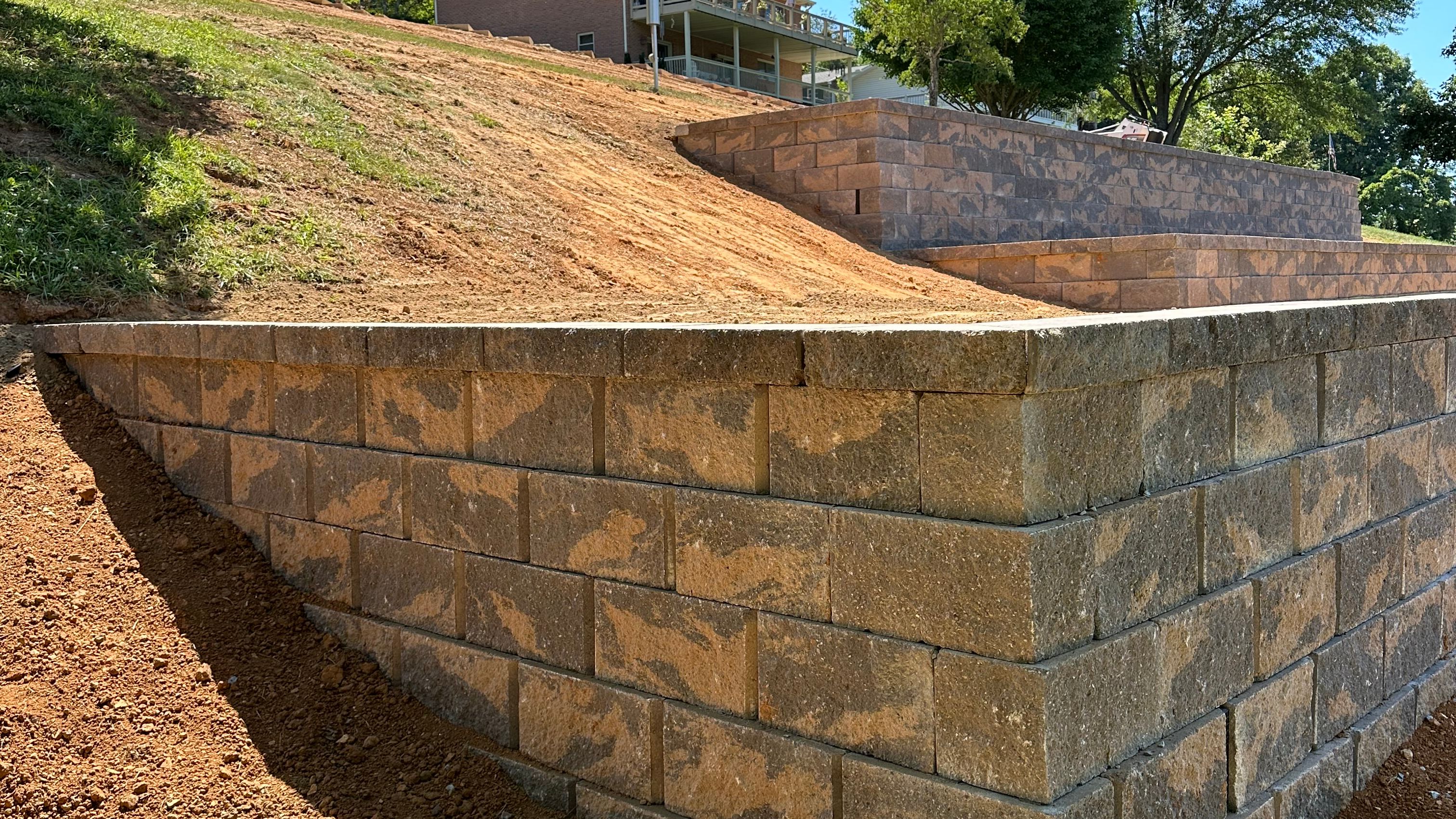
Retaining walls in East Tennessee have to do more than look good. Between heavy spring rains, clay soil that holds water, and winter freeze-thaw cycles, the wrong retaining wall materials can lead to bulging, cracking, or premature failure.
At Rock Solid in Kingston, we build and maintain walls across Roane County and nearby communities, and we see the same decision come up in almost every consultation: segmental block vs stone retaining wall. Both can be excellent when designed and installed correctly, but they behave differently in our climate, they drain differently, and their costs are driven by different factors.
In this guide, we will walk you through how segmental retaining wall systems and natural stone retaining wall builds compare for durability, drainage, aesthetics, and budget. You will also learn what matters most for East Tennessee retaining walls, including base preparation, water management, and when engineering should be part of the plan.
Why East Tennessee retaining walls fail (and how materials play a role)
First is water. Our storms can drop a lot of rain in a short window, and clay soil slows infiltration. When water builds up behind a wall, it creates hydrostatic pressure that pushes outward. Even a strong wall material can fail if drainage is missing or clogged.
Second is freeze-thaw durability. We do not have constant deep freezes like the upper Midwest, but we do have repeated cycles where moisture in the soil freezes, expands, and then thaws. That movement can shift poorly compacted base material, open joints, and create voids behind the wall.
Third is site access and slope geometry. Many properties in Kingston, Roane County, and the surrounding lake and ridge terrain have tight access, steep grades, and drainage paths that concentrate runoff. The best retaining wall material on paper can become the wrong choice if it cannot be installed correctly given access, wall height, or the need for proper reinforcement.
Material choice matters because it influences how the wall is engineered, how it drains, and how it is repaired if something changes later.
Segmental block retaining walls: how they work and where they shine
Durability in freeze-thaw cycles
Quality SRW blocks are made to handle outdoor exposure, and when installed on a properly compacted base with good drainage, they perform very well in East Tennessee freeze-thaw conditions.
Where we see problems is not usually the block itself. It is the base, backfill, or water management. If the base settles unevenly, the wall can step down or lean. If water is trapped behind the wall, pressure increases and movement accelerates.
Drainage needs for heavy rains
SRW systems are designed with drainage in mind, but they still require the right details.
In our installs, we typically plan for:
- Free-draining gravel backfill directly behind the wall
- A perforated drain pipe at the base that outlets to daylight when possible
- Proper grading at the top so surface water does not pour behind the wall
- Filter fabric or separation strategies where needed to reduce fines migration
If you want a deeper breakdown of what “done right” looks like, see our related post: Retaining Wall Drainage: Gravel, Pipe and Weep Holes Explained.
Aesthetics and design flexibility
Modern segmental block walls have come a long way. You can choose from multiple textures, colors, and cap styles, and you can build curves, corners, and tiered walls that fit the property.
Block is often a strong fit when you want:
- A clean, consistent look
- Matching steps or columns in the same product line
- A wall that integrates with patios, walkways, or outdoor living features
Because we also build outdoor spaces as part of our Hardscaping service, we often design block walls as part of a larger plan that includes paver patios, steps, and drainage improvements.
Typical cost drivers for block
When property owners ask for a retaining wall cost comparison, block walls often come in at a predictable range because the units are standardized and installation follows a proven system.
The biggest cost variables we see locally include:
- Wall height and whether geogrid reinforcement is required
- Excavation volume and disposal needs
- Access for equipment (especially on lake lots or tight backyards)
- Drainage complexity and outlet options
- Wall length and number of corners or curves
Block is not always “cheap,” but it is often cost-efficient for taller structural walls because it is engineered and repeatable.
Natural stone retaining walls: performance, appearance, and practical realities
In East Tennessee, stone is popular because it looks at home with our terrain and architecture, especially around wooded properties and lakefront homes.
Durability and freeze-thaw durability
Stone itself is durable, but the wall system matters.
- Dry-stacked stone can perform well because it can flex slightly with minor movement, and water can pass through joints. That said, it requires skilled stone selection and placement, and it is typically best for shorter walls unless engineered as a reinforced system.
- Mortared stone can look beautiful, but freeze-thaw cycles can be hard on mortar joints if water gets behind the face or if the wall lacks proper drainage. When mortar cracks, water intrusion can accelerate deterioration.
From our experience, stone walls hold up best here when they are treated like a retaining system first, not a decorative feature first. That means base depth, backfill, drainage, and, when needed, engineering.
Drainage needs in clay soil and heavy rains
Stone walls often get underestimated on drainage because people assume “water will just go through the joints.” Sometimes it will, but that does not eliminate pressure in saturated clay behind the wall.
For a stone retaining wall in our area, we still plan for:
- Excavation to competent subgrade
- A compacted base (often crushed stone)
- Gravel drainage zone behind the wall
- A drain pipe and a reliable outlet path
If your property already struggles with runoff or soggy areas, it is smart to think about the wall and drainage together. In some cases, a wall project becomes the right time to add swales, downspout routing, or other drainage solutions as part of Landscaping.
Aesthetics and curb appeal
This is where stone often wins hearts. Natural stone has variation in color, texture, and size that manufactured products cannot fully replicate.
Stone is a great fit when you want:
- A timeless, high-end look
- A wall that blends into natural surroundings
- A “one of a kind” finish that complements boulders, creek beds, or native plantings
It also pairs well with East Tennessee planting palettes. If you are building a wall near trees, keep root impact in mind, especially with larger species. Our post Best Trees for East Tennessee Yards: Roots, Shade, and Clay can help you avoid common placement mistakes.
Typical cost drivers for stone
Stone pricing can vary widely, which is why a simple “stone is more expensive” statement is not always accurate. The real answer depends on the stone type, wall style, and labor.
Common cost drivers include:
- Stone sourcing and delivery (local availability matters)
- Sorting and fitting time (labor is a major component)
- Wall height and whether reinforcement is needed
- Whether the wall is dry-stacked or mortared
- Complexity of curves, steps, and transitions
In many projects we quote around Kingston, Loudon, and Lenoir City, stone becomes more attractive when the wall is shorter and the goal is premium aesthetics. For taller structural walls, block often provides a cleaner engineering path and more predictable budget.
Block vs stone retaining wall in East TN: side-by-side comparison
When you are evaluating retaining wall materials, it helps to compare them by the factors that actually influence performance here.
Durability and longevity
Both can last for decades.
- Segmental block longevity is strongly tied to base compaction, drainage, and reinforcement design. The units are consistent and designed for retaining applications.
- Natural stone longevity depends on the wall type and craftsmanship. Dry-stack can be very durable for shorter walls. Mortared stone can be durable too, but it is more sensitive to water management and joint maintenance.
Drainage and water pressure
This is the deciding factor on many East Tennessee retaining walls.
- Block walls are commonly installed with a full drainage system and gravel backfill because that is part of the standard.
- Stone walls sometimes get built without enough drainage because they are assumed to be “naturally draining.” In our climate, that assumption can be expensive.
If you are comparing quotes, ask each contractor to specify the drainage details in writing. If you are not seeing gravel backfill volume, pipe location, and outlet plan, you are not really comparing apples to apples.
Freeze-thaw performance
Freeze-thaw issues show up as movement, cracking, or joint failure.
- Block systems handle freeze-thaw well when water is managed and the base is below the zone of seasonal movement.
- Stone can also handle freeze-thaw well, but mortared joints and poorly drained backfill can create weak points.
Aesthetics and architectural fit
- Block gives a consistent, clean look and often matches other hardscape features.
- Stone gives a natural, premium look with unique character.
Repairability and future changes
- Block walls are modular and often easier to repair in sections.
- Stone repairs depend on the build style. Dry-stack can be reworked, but matching stone can be challenging. Mortared stone repairs can be more visible.
Budget and retaining wall cost comparison
For many properties, the budget difference comes down to labor and wall height.
- Block is often cost-effective for taller structural walls with reinforcement.
- Stone can be cost-effective for shorter walls where the value is in aesthetics, but it can rise quickly with height and complexity.
If you want a deeper look at what changes pricing locally, see Retaining Wall Cost in Oak Ridge: Factors That Change Price.
What we look at on-site before recommending retaining wall materials
When we meet with property owners in Kingston and nearby communities like Knoxville and Oak Ridge, we do not start with a catalog. We start with the site.
Wall height, slope, and load behind the wall
We consider:
- Total retained height (including buried block or stone)
- Slope above the wall and whether it sheds water toward the wall
- Surcharges like vehicles, structures, or steep banks
- Space available for reinforcement (geogrid needs room)
Soil type and water movement
Much of our region has clay-heavy soils that can stay wet. We look for signs of seasonal saturation such as moss lines, soft spots, and sediment trails.
If the property has chronic runoff, we may recommend addressing drainage first or alongside the wall. Otherwise, even the best retaining wall materials will be stressed.
Access and staging
Material choice can be influenced by how we can safely stage the job.
- Can equipment reach the wall line without tearing up the yard?
- Is there room for gravel, block pallets, or stone stockpiles?
- Are there septic fields, utilities, or tree roots to protect?
Access constraints can make stone less practical on some sites because it often requires more handling time and sorting space.
Local permitting and engineering considerations
In Roane County and other municipalities, wall height, location, and drainage discharge can affect whether permits or engineering are needed.
Before you commit to a design, we recommend understanding the rules that may apply to your property. Our post Retaining Wall Permits in Roane County: What to Know First is a helpful starting point.
We also want to be transparent: we cannot determine permit requirements for every site in a blog post. Regulations can change, and site specifics matter. When we quote a project, we will talk through what we are seeing and what documentation may be required.
Practical recommendations: choosing the right wall for your property
Most property owners are not looking for the “best” wall in the abstract. You are looking for the best wall for your slope, your drainage, your style, and your budget.
Choose segmental block when you need structure and predictability
- The wall is taller or needs reinforcement
- You want a clean, consistent finish
- You need predictable performance in heavy rain
- You want easier future repairs or modifications
This is a common choice for properties that need terrace creation, driveway support, or clear grade control.
Choose natural stone when aesthetics are the priority and the wall is right-sized
- The wall is shorter and primarily improves landscape usability
- You want a high-end, natural look
- The property style calls for stone features
- You are willing to invest in craftsmanship and proper drainage
Stone is also a strong option when you are blending a wall into boulder landscaping or pairing it with a dry creek bed or naturalistic planting.
Consider hybrid approaches
Some of our favorite projects combine the strengths of both.
Examples include:
- Segmental block for the structural portion, with stone veneer accents where appropriate
- Block wall core with a natural stone cap that ties into other stonework
- Stone landscape walls for small terraces, with a reinforced block wall where the grade change is largest
The goal is not to force one material everywhere. It is to match the system to the site.
Installation details that matter more than the material
If you take one thing from this post, let it be this: a well-designed drainage and base system is what protects your investment.
Whether you choose block or stone, we focus on:
- Excavation to remove soft or organic soil
- A compacted crushed stone base built to the wall system requirements
- Proper wall batter (the slight backward lean that helps resist pressure)
- Correct backfill materials and compaction in lifts
- A drainage plan that includes an outlet, not just a pipe
For ongoing performance, maintenance matters too. Keeping downspouts routed correctly, preventing mulch from clogging outlets, and avoiding heavy loads near the top of the wall can extend the life of any wall system. If you want help keeping outdoor features performing year-round, our Property Maintenance team can support you.
Conclusion: pick the wall that fits East Tennessee weather and your goals
Choosing between block vs stone retaining wall options is not just a style decision. In East Tennessee, retaining wall materials must handle heavy rains, clay soil, and freeze-thaw durability challenges. Segmental block walls offer engineered strength, predictable installation, and straightforward repairability. Natural stone walls offer unmatched character and a premium look, especially when the wall height and drainage plan are right.
If you are in Kingston, Roane County, or nearby towns and you are comparing options before requesting quotes, we are happy to help you evaluate your site and recommend the best path forward. Start by exploring our Hardscaping services, and when you are ready, reach out through our website to schedule a consultation.


