

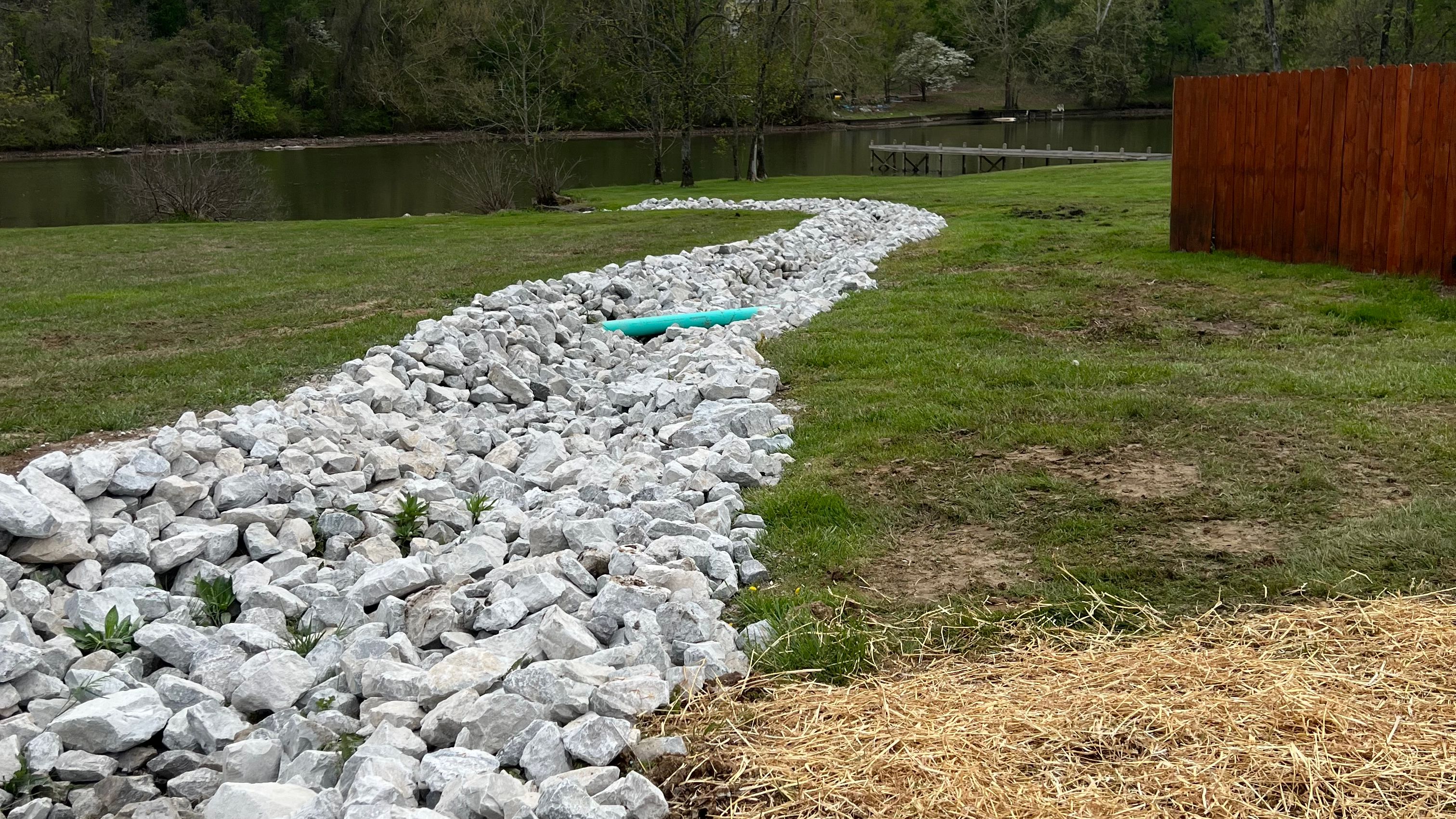
Clay soil erosion in East Tennessee is frustrating because it can look fine for weeks, then one sudden downpour turns a hillside into a muddy chute. We see it all the time around Kingston and across the region: bare patches appear, mulch migrates downhill, a trench forms where runoff concentrates, and you start losing topsoil with every storm.
In this guide, we will explain why our red clay and fast, heavy rain cause slope washouts, then walk through proven ways to stop erosion on a slope. You will learn how to spot the real cause (it is usually concentrated water, not just “steepness”), how to use grading for erosion control, when a swale vs berm drainage approach makes sense, and where riprap installation or groundcover for erosion control can be the right long-term fix. We will also cover when DIY is reasonable and when it is time to bring in a pro for slope stabilization landscaping.
Why East Tennessee clay and sudden downpours cause slope washouts
East Tennessee hillsides are a perfect storm for erosion. We have rolling terrain, a lot of disturbed soils around homes, and clay that behaves differently than sandy or loamy soil. Add intense rain events and you get runoff that moves fast and carries soil with it.
Clay soil sheds water when it is compacted or bare
Clay particles are tiny and pack tightly. When clay is healthy and well-structured, it can absorb water better than most people expect. The problem is that on many slopes, the clay is:
- Compacted from construction traffic, mowing, or foot traffic
- Low in organic matter, which reduces aggregation
- Bare or thinly covered, so raindrops hit soil directly
When a heavy rain hits compacted clay, water cannot infiltrate quickly. Instead, it sheets across the surface, picks up fine particles, and starts carving channels.
Downpours create “concentrated flow,” which is what actually cuts gullies
Most major washouts are not caused by uniform sheet flow across a whole slope. They happen when water gets funneled into a path.
Common causes we find on Roane County and Knoxville area properties include:
- A downspout dumping onto a hillside
- A driveway or sidewalk edge that channels water
- A swale that was never finished properly after construction
- A low spot behind a bed edge that overflows in storms
- A neighbor’s runoff entering at the property line
Once runoff concentrates, it gains speed, and speed is what strips soil. If you only add mulch or seed without addressing the concentration point, the erosion returns.
Freeze-thaw and seasonal timing make slopes more vulnerable
While East Tennessee is not as harsh as northern climates, we still get freeze-thaw cycles. On slopes, that can loosen soil structure and expose roots. Combine that with late winter and early spring rains when turf is thin, and erosion can accelerate.
If you are trying to stabilize a slope, timing matters. Establishing vegetation in fall or spring often works better than mid-summer, when heat stress makes it harder for roots to take.
Start with diagnosis: where is the water coming from and where is it going?
Before you buy rock, plants, or erosion mats, take one rainy day (or a hose test) and map the runoff. This is the step most homeowners skip, and it is why quick fixes fail.
What to look for after a storm
Walk the slope once the rain stops and the ground is safe to step on. Look for:
- Rills (small channels) that point to the flow path
- Exposed roots or undercut turf edges
- Sediment fans at the bottom of the slope
- Mulch piles where material collected after moving downhill
- A single “starting point” where a gully begins
That starting point is often the real problem. Fixing it can reduce erosion dramatically even before you do any planting.
Simple “flow tracing” test
If you cannot catch a storm, you can still learn a lot.
- Run a hose at a moderate rate near the top of the slope for 10 to 15 minutes.
- Watch where water starts to gather and how it travels.
- Mark the path with small flags or landscape paint.
If water is traveling in a narrow line, you need to slow it down, spread it out, or intercept it.
Safety and property considerations
If runoff is coming from a roofline or a neighbor’s yard, be careful. Redirecting water can create new problems if it discharges onto someone else’s property or toward a foundation. In many cases, the best approach is to keep water on your property and guide it to a stable outlet.
For bigger changes, we recommend checking local requirements and setbacks. For example, if your stabilization plan involves a retaining wall, it is worth reviewing what may apply in Roane County. Our guide on Retaining Wall Permits in Roane County: What to Know First is a helpful starting point.
Grading for erosion control: fix the slope shape before you armor it
When homeowners ask us how to stop erosion on a slope, the most effective long-term answer is usually some form of grading for erosion control. That does not always mean redoing the entire yard. Often it means subtle reshaping that changes how water behaves.
The goal: slow water, spread water, and give it a stable outlet
- Does not concentrate runoff into a single fast channel
- Has consistent surface cover (plants, mulch, rock, or a combination)
- Sends water to a place that can handle it (a swale, a dry creek bed, a rain garden, or a proper drain)
Common grading fixes that work well in East TN clay
Here are grading moves we use frequently in Kingston area projects:
- Feathering and smoothing small dips that collect and then spill water
- Creating a gentle “bench” (a flatter strip) partway down a long slope to break up flow
- Rebuilding the top edge so water does not roll over like a waterfall
- Correcting negative grade near structures so water does not run toward the house
Even small changes can reduce the energy of runoff.
Compaction and soil conditioning matter
Clay can be graded beautifully and still erode if it is left slick and compacted. After shaping, we often recommend:
- Loosening the top few inches (without destabilizing the slope)
- Adding compost or soil conditioner to improve structure
- Avoiding over-tilling, which can create a weak layer that washes
The goal is a surface that can accept water and support roots.
If you are dealing with standing water elsewhere in the yard, targeted drainage solutions can help without regrading everything. This pairs well with slope work. See How to Fix a Soggy Yard in Loudon Without Regrading Everything.
Swale vs berm drainage: which one actually helps on a hillside?
What a swale does (and when it is a good idea)
- You need to intercept runoff moving downhill
- You want to redirect water to a safer outlet
- You have a defined flow path that keeps cutting the same trench
What a berm does (and when it is a good idea)
- You need to keep water away from a foundation or patio
- You want to push sheet flow away from a problem area
- You are creating a planting bed that also functions as a water deflector
In practice, we often use a small berm with a swale, meaning the berm creates a “backstop” and the swale becomes the controlled path.
Key detail: every swale needs a stable outlet
This is where many DIY swales fail. If you intercept water but dump it onto bare clay at the end, you just move the erosion problem.
Stable outlets can include:
- A rock-lined section (mini riprap)
- A dry creek bed
- A rain garden designed for clay soils
- A connection to an existing drainage path that is already stable
If you want a deeper comparison of drainage approaches, our post French Drain vs. Dry Creek Bed for East TN Drainage is a good next read.
Groundcover for erosion control: the most natural way to stabilize a slope
Plants are one of the best long-term erosion control tools because roots hold soil, foliage reduces raindrop impact, and healthy groundcover improves infiltration over time. The key is choosing the right groundcover for erosion control and installing it in a way that can survive our weather.
What makes a good slope groundcover in East Tennessee?
On slopes, we look for plants that:
- Spread and knit together, rather than staying in isolated clumps
- Have fibrous roots that grip soil
- Tolerate clay and periodic saturation
- Match the light conditions (full sun vs shade)
- Can handle heat and humidity
We also pay attention to maintenance. Some homeowners want a “set it and forget it” slope, while others are fine with seasonal trimming.
Planting tactics that reduce washouts
Even the right plant can fail if the installation is not slope-smart. We often use:
- Staggered spacing (triangular pattern) to close gaps faster
- Terraced planting pockets on steeper grades
- Erosion control blankets (jute or coir) to hold seed and soil while plants establish
- Mulch that stays put, like shredded hardwood, applied at a reasonable depth
On clay slopes, thick, fluffy mulch can float in a downpour. Shredded mulch tends to interlock better than large nuggets.
Turf can work, but it needs the right establishment plan
Grass is a type of groundcover, but it is not always the best erosion control on steep slopes, especially in shade or where runoff concentrates.
If you choose turf:
- Address drainage first, so water is not carving channels
- Prep soil so roots can penetrate (compaction is the enemy)
- Use the right establishment method (seed, straw, erosion mat, or sod)
If you are weighing turf options, these resources can help you plan:
- Sod vs Seed in East Tennessee: Costs, Timing & Success Rates
- When to Install Sod in East TN: Best Timing and Prep for a Rock Solid Lawn
Trees and shrubs: great for stability, but place them intentionally
Woody plants can anchor slopes, but they also change water movement and can create maintenance challenges if placed poorly.
We often recommend mixing shrubs with low groundcover for layered stability. If you are choosing plants specifically for clay, our guides can help:
- Best Trees for East Tennessee Yards: Roots, Shade, and Clay
- Native Plants for East TN: Low-Maintenance Landscape Picks
Riprap installation and rock solutions: when “armoring” the slope makes sense
Sometimes vegetation is not enough, especially where water is already concentrated or where the slope has a defined channel. In those cases, rock can be the right tool.
What riprap is (and what it is not)
Riprap is a layer of appropriately sized rock placed to resist erosion from flowing water. It is not just “throwing some stone down.” Proper riprap installation involves:
- Choosing rock size that matches flow energy
- Using a filter layer (often geotextile fabric or a graded aggregate) to keep soil from pumping through the rock
- Extending the rock far enough up and down the flow path
- Creating a stable transition at the top and bottom
If you skip the filter layer, clay can wash out from underneath, and the rock settles into a mess.
Where riprap works well on East TN properties
We commonly use riprap for:
- Downspout splash zones on steep ground
- Swale outlets where water speeds up
- Channels that function like a seasonal creek
- The toe of a slope where sediment collects and flow concentrates
Pairing rock with plants for a better look and performance
- Rock in the main flow line
- Groundcover and shrubs on the adjacent slope
- A defined edge so rock stays where it belongs
This is also where hardscaping details can matter, especially if you are combining drainage with steps, a path, or a seating area. Our team handles these kinds of integrated projects through our Hardscaping service.
A practical “fix ladder” for slope stabilization landscaping
Not every slope needs the same level of intervention. Here is the progression we usually recommend, from simplest to most robust.
Level 1: Stop the obvious water sources
- Extend downspouts to a stable discharge point
- Fix broken splash blocks
- Redirect sump pump discharge away from the slope
- Clean clogged gutters so water is not overflowing in sheets
Level 2: Protect bare soil immediately
If you have exposed clay right now, do not leave it unprotected through storm season.
- Apply erosion control blanket on the steepest sections
- Use temporary groundcover seed where appropriate
- Mulch lightly with interlocking shredded mulch
Level 3: Regrade small problem areas
- Smooth dips and ruts
- Build a small bench to break up a long run
- Correct the top edge so water does not “lip over”
Level 4: Add a swale, berm, or defined drainage feature
- Install a swale with a stable outlet
- Add a small berm to protect structures
- Consider a dry creek bed for a natural look and durable performance
Level 5: Armor high-energy zones and reinforce with plants
- Riprap installation in channels and outlets
- Rock-lined downspout runs
- Dense groundcover for erosion control on adjacent areas
Level 6: Structural solutions when the slope is failing
If the slope is slumping, cracking, or threatening a driveway or home, you may need a structural approach like a retaining wall with proper drainage.
Retaining walls are not just about blocks or stone. They are drainage systems first. If you are researching walls, our post Retaining Wall Drainage: Gravel, Pipe and Weep Holes Explained can help you understand what “done right” looks like.
For homeowners who want a professional plan and installation, we often combine drainage, planting, and hardscape details through our Landscaping service.
When to call a pro (and what we evaluate on-site)
Some erosion problems are safe and reasonable to tackle yourself. Others can create expensive damage if handled incorrectly. We recommend calling a pro when:
- A gully is forming deeper than a few inches and expanding each storm
- Runoff is moving toward a foundation, crawl space, or basement
- You see slope slumping, cracks, or leaning trees
- The fix requires heavy grading, equipment access, or hauling rock
- You suspect a retaining wall is needed, especially near property lines
What we look at during an erosion and runoff visit
When we evaluate clay soil erosion in East Tennessee, we focus on:
- Water sources (roof, driveway, neighboring runoff)
- Soil condition (compaction, structure, existing root mass)
- Slope length and steepness (long slopes build speed)
- Outlet options (where water can safely go)
- Aesthetics and maintenance goals (naturalized vs manicured)
We also consider how solutions will hold up in our local climate, including heavy spring rain, summer downpours, and winter freeze-thaw.
If you are in Roane County or nearby areas like Knoxville, Lenoir City, Loudon, or Oak Ridge, we build plans that match local soils and typical storm patterns.
Conclusion: stop erosion by controlling water first, then stabilizing soil
If you are dealing with slope washouts, the most important step is to stop guessing and start tracking water. East Tennessee clay is not “bad soil,” but it is unforgiving when runoff concentrates and the surface is bare or compacted. The best results come from a one-two approach: manage water with smart grading, swales, or outlets, then stabilize the soil with the right groundcover, mulch strategy, and targeted rock where flow is strongest.
If you want help choosing the right fix, our team at Rock Solid in Kingston can evaluate your slope, identify the source of runoff, and recommend a plan that fits your property and budget. Learn more about our Property Maintenance and Landscaping services, and reach out when you are ready to stop losing soil after every storm.


